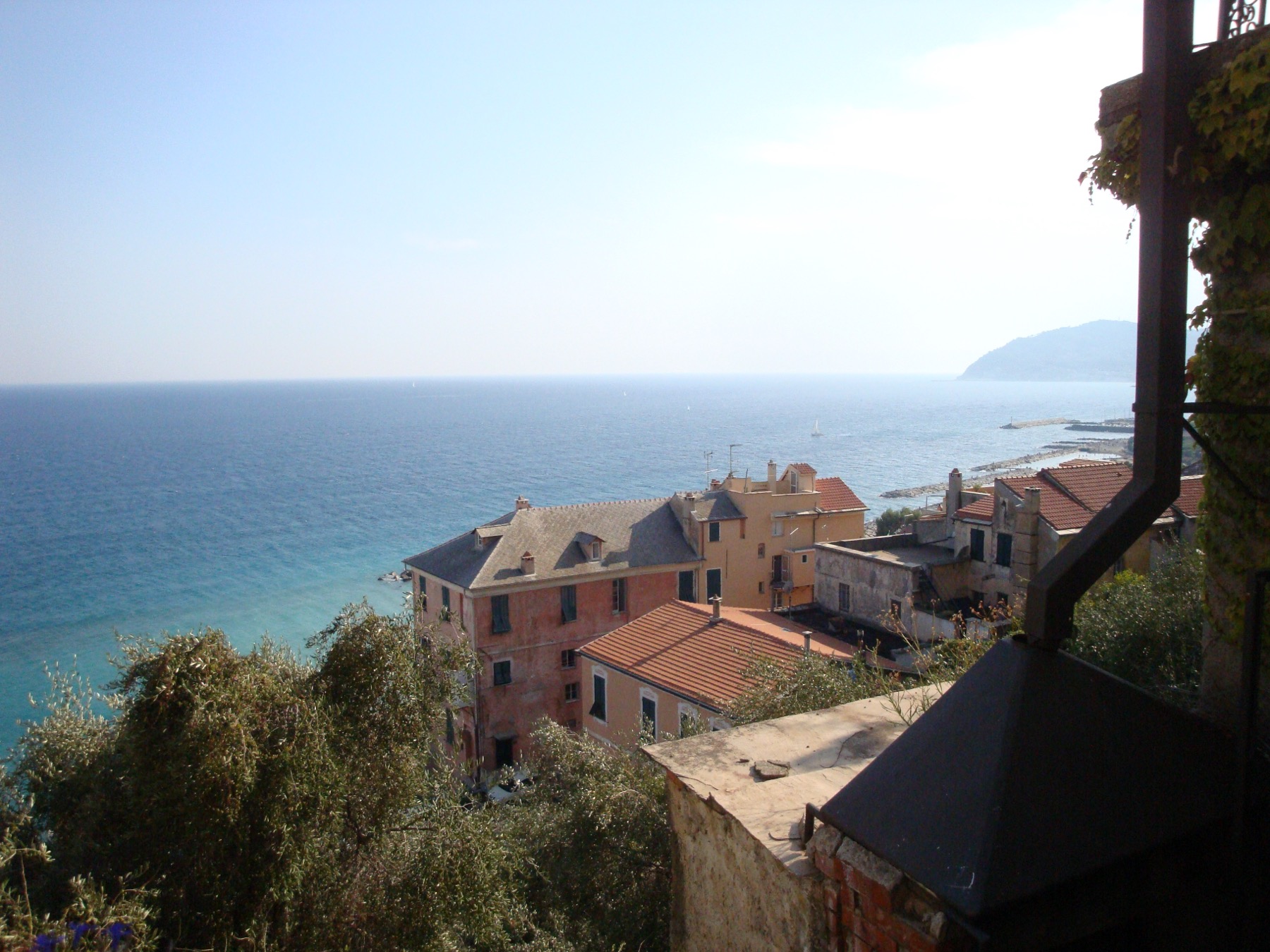
If I had to choose one single place in the whole western Riviera, I'd choose Cervo. I love old villages, and Cervo, to me, is the village: my refuge, the place that relaxes me more than anywhere in the world. I know I'm biased — it won me over years ago and never let go — but let me say it anyway.
There's a village, fifteen minutes from home, that you see from far off long before you reach it. It rises from the sea all in one piece, sand-coloured, with a church at the top that looks like it was put there to serve as a lighthouse. It's Cervo, and every time I drive past I have to slow down.
It sits on the eastern side of the gulf, between Imperia and Diano Marina, less than ten kilometres from the centre. By car, from Oneglia, you reach it in barely fifteen minutes along the Aurelia. It's one of Italy's "Borghi più belli", one of the genuine ones, not the postcard kind: medieval, vertical, made of lanes that climb and houses that lean on one another.
The first thing to know is the nickname, because it tells you everything. They call Cervo the village of the corallini, the coral fishers, but there's another name too, a darker one that goes around here: the village of the hundred widows. Oral tradition speaks of a storm that sent the fishermen's boats to the bottom, leaving a row of women alone at home. These are stories handed down by word of mouth, take them for what they are, but they give you a good sense of what kind of people this was: sea people, who took everything from the sea and paid the sea back.
And the sea, here, meant coral. In the sixteen and seventeen hundreds the men of Cervo would sail all the way to the waters of Corsica and Sardinia to fish it, and come back loaded with that precious red that they then worked and sold. With the coral money they funded much of their church. That's why they call it the church of the Corallini.
And the church is the reason you climb all the way to the top.
It's named San Giovanni Battista, the same patron saint we celebrate in Oneglia with the fireworks over the sea, and once you're up there you understand why people talk about it so much. The façade is Baroque, concave, undulating like a curtain billowing in the wind, and it looks straight out to the water. A local architect, Gio Batta Marvaldi, began it in 1686, and his son Giacomo Filippo finished it. It was consecrated in 1736, and the bell tower went up in 1771. It's one of the most important Baroque monuments in the whole western Riviera, and you notice it without anyone needing to tell you: white and pink against the blue, suspended over the gulf.
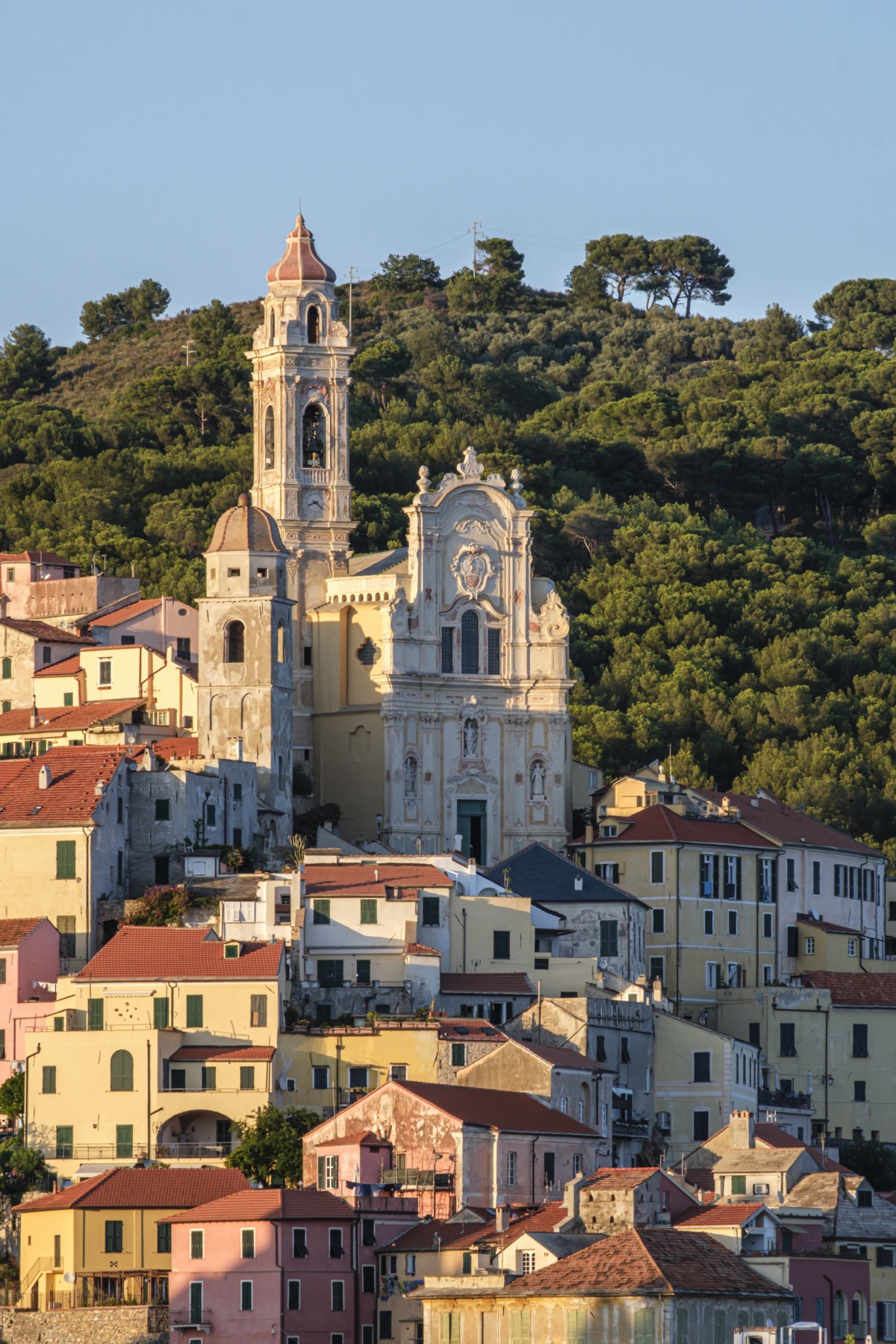 The church of the Corallini at the top of the village: the curved Baroque façade and the bell tower rising above the sand-coloured houses.
The open space in front of the church is called Piazza dei Corallini, but we just say the sagrato, the church terrace. It's a natural balcony, with the sea just below and the village dropping away behind your back.
And it's here that, in summer, the most beautiful thing happens.
Since 1964, thanks to a Hungarian violinist named Sándor Végh, that terrace hosts the International Chamber Music Festival. On summer evenings the square turns into an open-air auditorium: musicians arrive from half the world, sit with their backs to the church façade and play, and you listen with the sea breathing a few metres below. There's no ceiling, there's the sky; there's no back wall, there's the lit-up Baroque. I'll be honest with you: it's one of those things that, if you happen to be in Cervo at the right time, you don't forget. The festival is in summer, so check the dates before you set off, but if you're there when they play, that's the evening you build your plans around.
Even without a concert, though, the climb is worth it. Cervo's lanes are the kind that make you get lost on purpose: arches, stairways, cats, low doorways, the odd craftsman's workshop and plenty of views that open suddenly onto the gulf. You see it all on foot, and you take it slow.
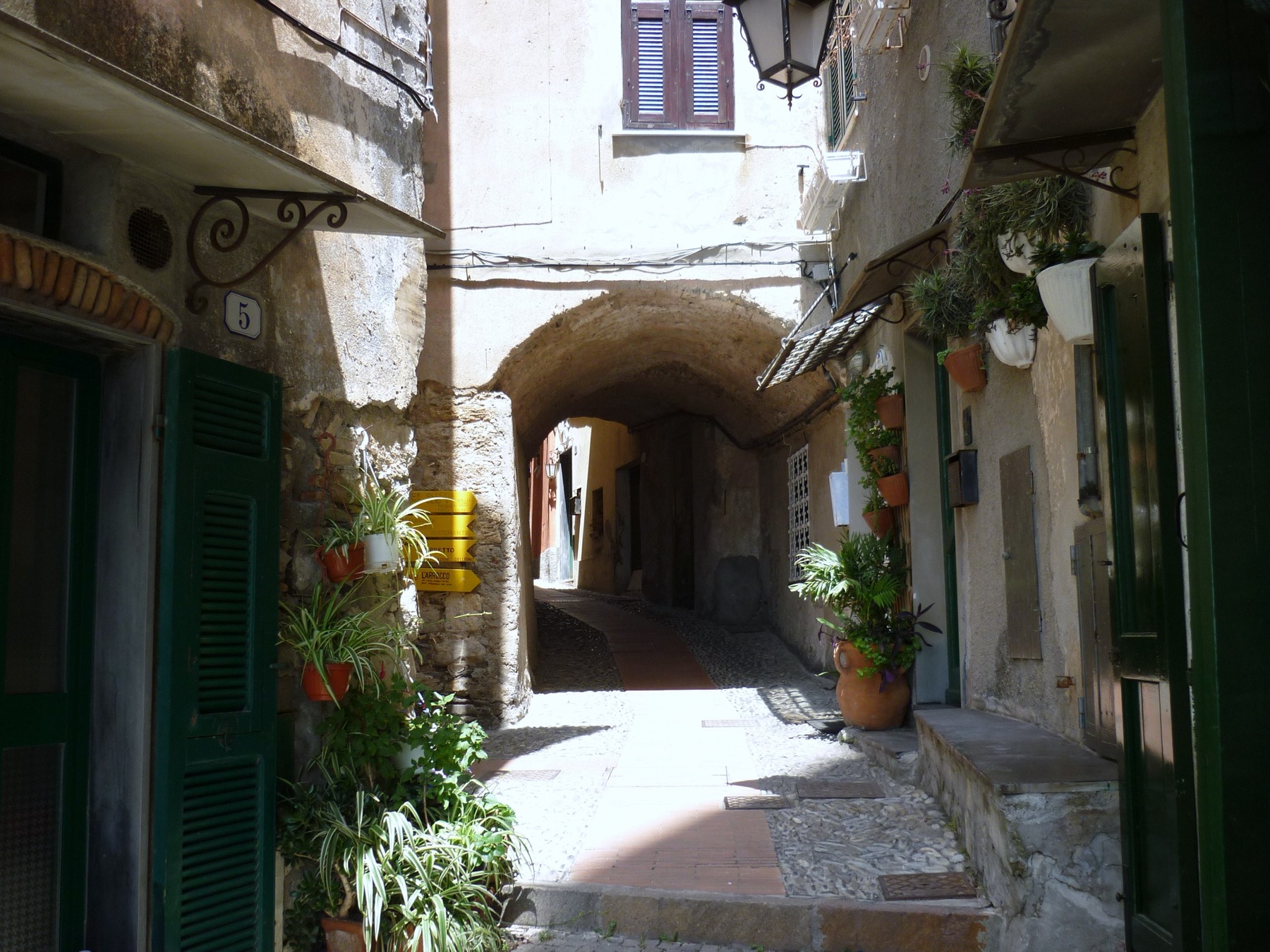 A climbing stone lane with its arch and pots of flowers on the doorsteps: this is how you wander the heart of the village, on foot and slow.
My ritual, when I go up, is the simplest in the world. I stop in the little square at the top, near the parking, sit down with an aperitivo, and everything starts from there: time, in Cervo, has stopped anyway — so what's the rush? The church square looking out over the sea I can't describe to you, and I won't even try: you have to live it. Then you lose yourself among the little craft shops, up and down the lanes, in that climbing and dropping that is already half the pleasure. If I'd had to invent an "endless" place myself, where the hours don't pass, I couldn't have imagined it this perfect. And what still amazes me is that, despite everything, Cervo has stayed authentic: it hasn't sold itself to tourism, it hasn't become a fake backdrop for photos. It's still a real village, and that's why it's mine.
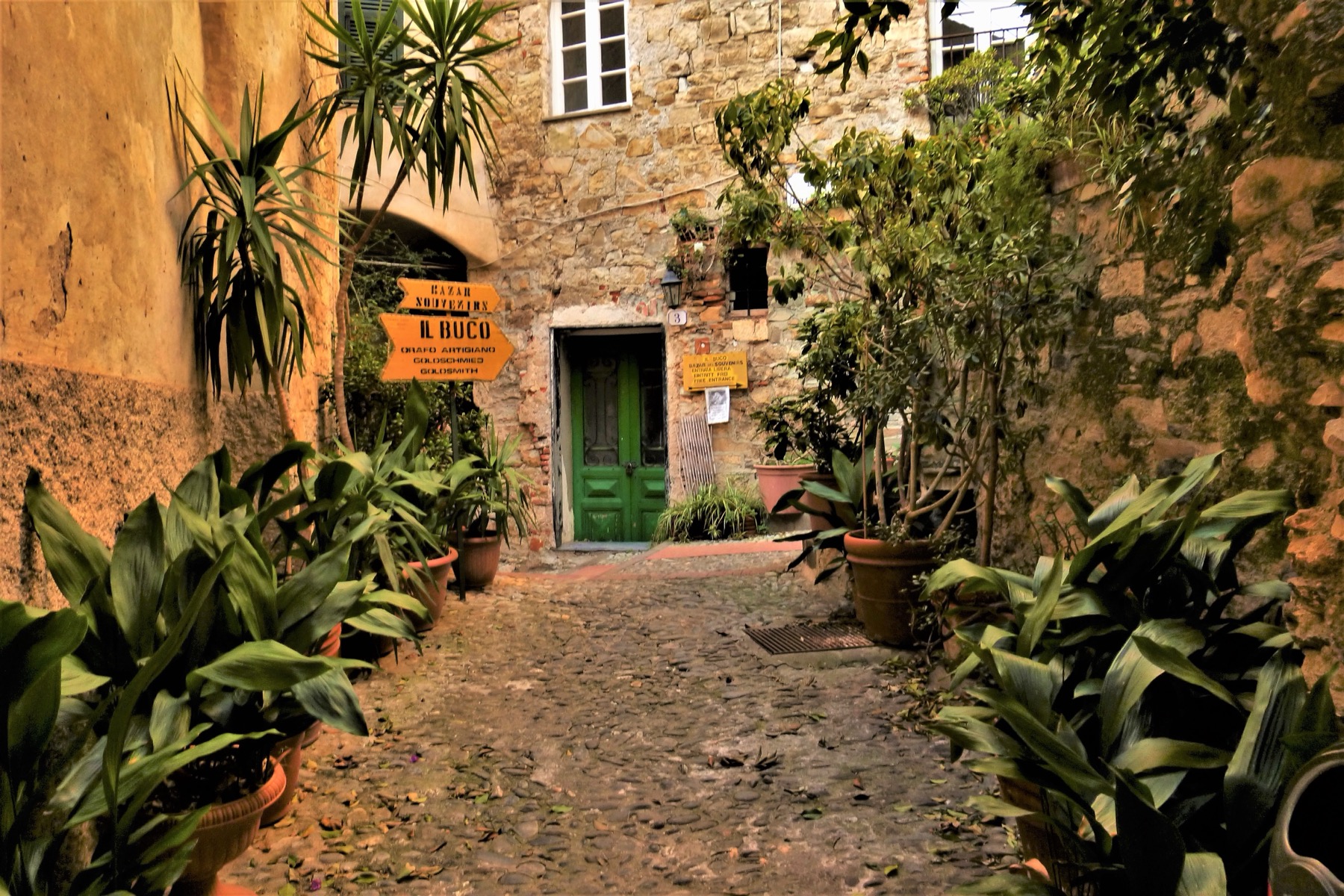 A craftsman's workshop tucked into one of the village lanes: a green door, pots of plants and the artisan goldsmith's signs above the cobblestones.
A practical tip, from someone who's been and refuses to tell brochure lies: parking is a pain. The village is closed to traffic and uphill, the spots are few and in summer they vanish early. Go early in the morning, or in the late afternoon for the evening, and make your peace with leaving the car a bit lower down and walking up. It's part of the deal.
And then there's the thing that has stayed in my heart, the one almost nobody tells you about. Below the village, on the sea, there's a little harbour: the Porteghetto. You come down to it from the Aurelia, it's a beach club on the water with a restaurant facing the sea. But the reason I keep going back is something else: the water. Right out front it's stunning, clean and clear, and perfect for a canoe or a kayak: the first time I paddled away from the shore I found myself gliding over a bottom you could see all the way down. Seen from there, with the village towering above and the coast opening up, Cervo is something else again. It's my favourite way to look at it: from the sea, in silence, with the church up there at the top.
If you get hungry, inside the village there's Serafino, a terrace over the sea where you eat fish from the gulf and where they bring the spaghetti straight to you in the pan. It's a proper dinner, and in summer it's best to book.
Cervo is the classic day trip you forget you have within reach. From Stella sul Mare it's fifteen minutes. On a summer evening, after a swim, climb up there: take the lanes slowly, reach the sagrato as the sun goes down, and with a bit of luck you'll find the music too. It's one of those evenings that, driving home, make you wonder why you don't do them more often. I said it from the start, I'm biased: Cervo won me over, and I don't hide it. But trust someone who's wandered plenty of places around here: if you can see only one village, see Cervo. You won't trade it for any other.
Where to find it
- Piazza dei Corallini and the church of San Giovanni BattistaThe terrace at the top of the village, in front of the curved Baroque façade, with the sea just below. In summer it becomes the stage of the International Chamber Music Festival.Piazza dei Corallini, Cervo (Imperia)
- Ristorante SerafinoA terrace over the sea inside the village: fish from the gulf and the spaghetti they bring you straight in the pan. Dinner spot, worth booking.Cervo (Imperia)