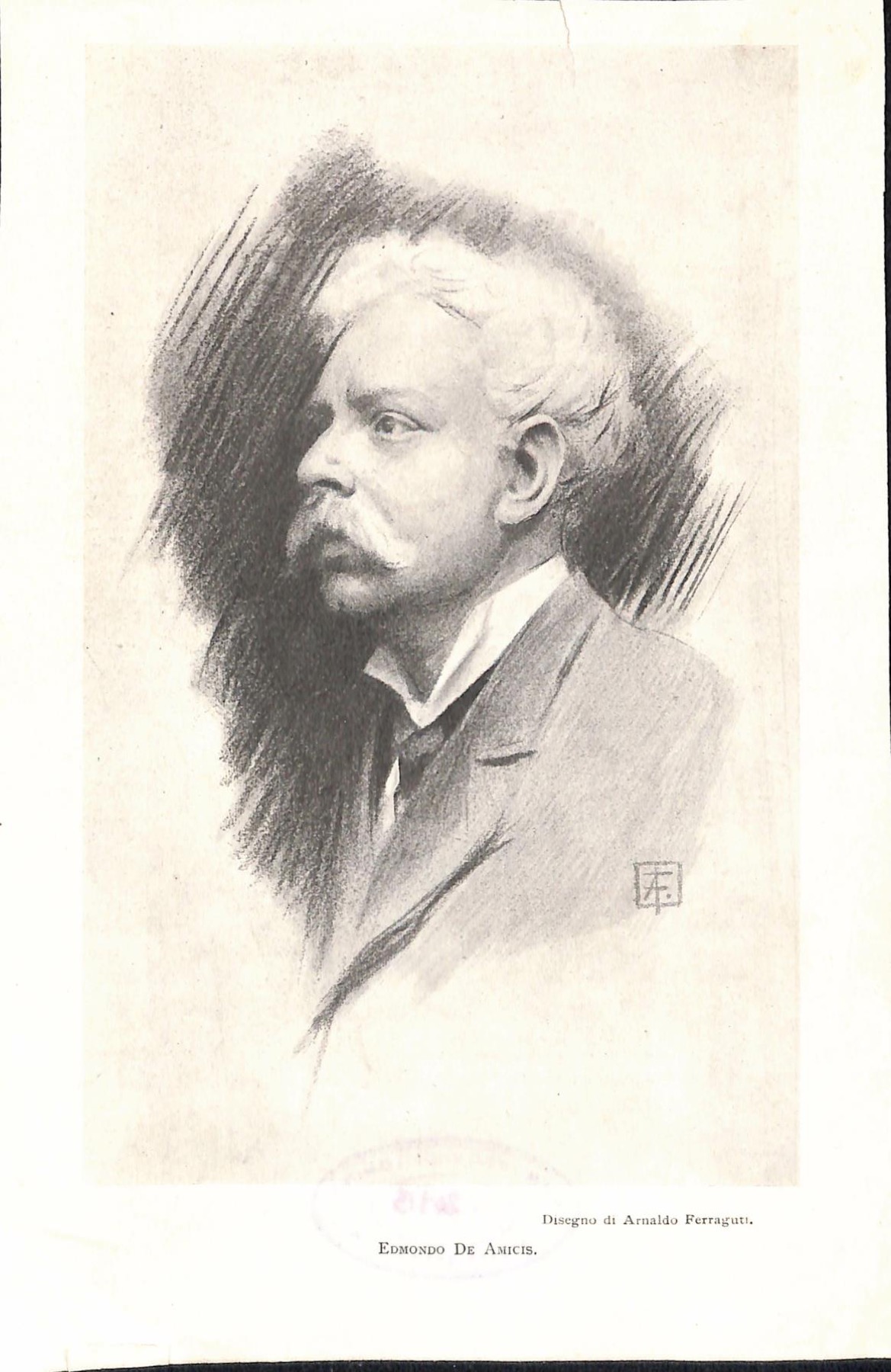
There's a square in Oneglia I've walked through a thousand times without paying much attention. It's called Piazza De Amicis. As a boy it was just a name to me, one of many, the kind you read on the plaque at the corner and never wonder where it came from. Then one day someone told me the most obvious thing in the world, and I felt a little foolish: De Amicis, the one who wrote Cuore, was born right there. In Oneglia. In my own town.
Edmondo De Amicis was born on 21 October 1846, right here, in the quarter once called San Francesco, named after the church and convent that stood here until the earthquake of 1887 took them away. His father, Francesco, was the royal banker of salt and tobacco; his mother, Teresa Busseti, came from the Alessandria area, from a good family. A middle-class birth, then, in a small seaside town of the Ponente, in an Italy that wasn't even Italy yet: unification would arrive fifteen years later.
And here I have to be honest, because around these parts honesty counts for more than looking good: De Amicis was born in Oneglia, but he didn't grow up here. The family left when he was tiny, in 1848, heading for Cuneo and then Torino, where he spent his childhood and his school years. His studies, his upbringing, his mind, all of that is elsewhere. Oneglia gave him his first breath and not much more. And yet that "born in Oneglia" remains, and it's one of those things a town holds on to tight.
The one who wrote Cuore
If you're Italian and over a certain age, you've run into "Cuore" whether you meant to or not. Maybe at school, maybe on a grandmother's nightstand. De Amicis published it in 1886, and it's the diary of a school year seen through the eyes of Enrico, a boy in third grade in Torino. Inside there are the classmates, the teacher, the essays, the small cruelties and the small acts of greatness of children. And then there are the famous monthly stories, the ones the teacher reads aloud: the little Florentine scribe, the Sardinian drummer boy, and above all "From the Apennines to the Andes," the boy who sets off from Genova and crosses half the world to find his mother, who emigrated to Argentina.
That book raised whole generations on one clear idea: that there is such a thing as love of country, respect, generosity toward those who have less, duty done without making a fuss. Today it sounds naive to some, even a little preachy, and in part it is. But there's one thing you can't take away from those pages: their sincerity. De Amicis truly believed in those values, so much so that later in life he leaned toward socialism, toward the cause of those who worked and struggled. He wasn't only the kindly author of children's books: he was a man who put his face on the Italy he wanted.
The square, the barracks, the study
Let's go back to the square, because that's where the story turns into a walk. The palazzo where De Amicis was born looks onto Piazza De Amicis, and today the Guardia di Finanza is housed inside. Yes, you read that right: the birthplace of one of Italy's most-read writers is a barracks. There's a plaque to remember the writer, and otherwise life carries on as if nothing happened, which is a very Oneglia kind of fate. No museum at the door, no queues, no ticket. A plaque, and you walking past.
On the same square, though, there's a detail few people know and that I love to bits. In the civic library Leonardo Lagorio, right there overlooking the piazza, some rooms hold De Amicis's study: his furniture, his things, brought back here to Oneglia. It's a small surprise, the kind you only discover if you step inside or if someone tells you. The local's tip is simple: before you go, call ahead or check the hours, because it's a small-town library, not a grand museum, and the hours are what they are.
And there's a third spot, which moves me a little. A plaque on the façade of a building overlooking Calata Cuneo, the harbour of Oneglia, also remembers the writer's birth. Think about it: the same harbour from which Sasso oil set sail and where the grain for Agnesi pasta arrived, the same harbour where people now sit out in the evening to drink and yachts come to moor, is the harbour beneath which the boy who would write "From the Apennines to the Andes" came into the world. A story of departures and homecomings that begins on a quayside in Oneglia.
Why I'm telling you this
I'm telling you because I think it's one of those things that make a place richer than it looks. From the outside, Oneglia can seem like any seaside town: the harbour, the olive groves on the hills, the market, the beach. Then you scratch a little and you find that Andrea Doria was born here, that Sasso oil and Agnesi pasta were born here, and that the man who taught half of Italy what duty and country meant came into the world in a square you now cross on your way to do the shopping.
I like this Oneglia that doesn't boast. A town that gave the world an author read across half the globe and simply put up a plaque about it, no fuss. Maybe that's exactly the point: the San Francesco quarter, the square, the library with the study, the plaque on the harbour. All within walking distance, all told in a low voice.
If you're around here, take a stroll through Piazza De Amicis with this in mind. Look at the façade of the barracks, picture the church of San Francesco that's no longer there, step into the library if it's open. And when you go down to the harbour in the evening, look for the plaque. It isn't a grand monument, there's no tourist coach. It's just Oneglia, in its own way, remembering one of its own.
Where to find it
- Piazza De AmicisThe square dedicated to the writer, in the old San Francesco quarter of Oneglia. Here stands the palazzo where he was born (today home to the Guardia di Finanza), and overlooking the same square is the civic library Leonardo Lagorio, which keeps De Amicis's study in some of its rooms. A few minutes on foot from Stella sul Mare.Piazza Edmondo De Amicis, Oneglia (Imperia)