There's one thing that always makes me smile when I take someone to Nice for the first time, starting from home: the idea that it's some grand expedition. It isn't. It's a day trip, the kind you decide over breakfast and you're there by lunch. From Oneglia the border is right around the corner, and once you're past Ventimiglia you're already on the Côte d'Azur.
For me, though, Nice is much more than a day trip. As a kid it meant holiday, the real thing: my family couldn't afford big journeys, but Nice, an hour from Imperia, plunged you into everything you look for when you travel — different people, different languages, before the year 2000 even a different currency. Things you couldn't do at home. You were on holiday without taking a plane. In my twenties it became something else again: I'd come down from Milan almost every weekend, and on Friday and Saturday nights, with Claudio — another brother-like friend — the only question was "Monte Carlo or Nice?". And let me let you in on something few people know: if you know where to go and what to do, a night out there costs less than dancing in Italy. Simone lives in Nice too, the goalkeeper of my water polo team, someone I shared the evenings of my youth with, between the Marina — that's what we people of Imperia call Borgo Marina — and Diano. So when I go back, it's never just sightseeing: it's a piece of my life that carries on across the border.
Let's start with the numbers, which is what I care about most and what you never find in the brochures. By train there's no direct connection: you change at Ventimiglia. From Imperia it's about three quarters of an hour down to the border, then you take the French regional train, the TER, which runs from Ventimiglia to Nice-Ville in roughly fifty to fifty-five minutes. All told, change included, count on an hour and three quarters, an hour and fifty. The Ventimiglia–Nice ticket costs a few euros, around ten one way, and trains run often, roughly every hour. It's the way I prefer: you get off at Nice-Ville and a fifteen-minute walk later you're on the seafront, no car to worry about.
If you go by car, it's just over seventy kilometres on the motorway, an hour to an hour and a quarter if the traffic is kind (in summer, near the border, it isn't always). The real catch is parking. Leaving the car in Nice for the day costs you around twenty-five to thirty euros in the city-centre garages; many of them give you the first hour free, but for a day out you need the whole day, so factor it in. One trick worth knowing: on Sundays and public holidays, on-street parking is free. If you go on a Sunday and find a spot along the avenues, you save a fair bit.
But the smartest move, by car, is another one: don't drive into the centre at all. Leave the car in one of the park-and-ride lots on the outskirts — here they're called ParcAzur — and take the tram. Nice has three modern lines (T1 and T2 are the most useful) that cut across the city quickly and simply, and the parking is free if you buy a same-day return ticket for public transport. No traffic, no hunting for a space: you step off the tram and you're already in the centre.
A word on the border, because some people still ask: you cross without stopping, we're in Europe, an ID card in your pocket is enough. Now and then the French police do checks, especially on the train, but it's a matter of a moment.
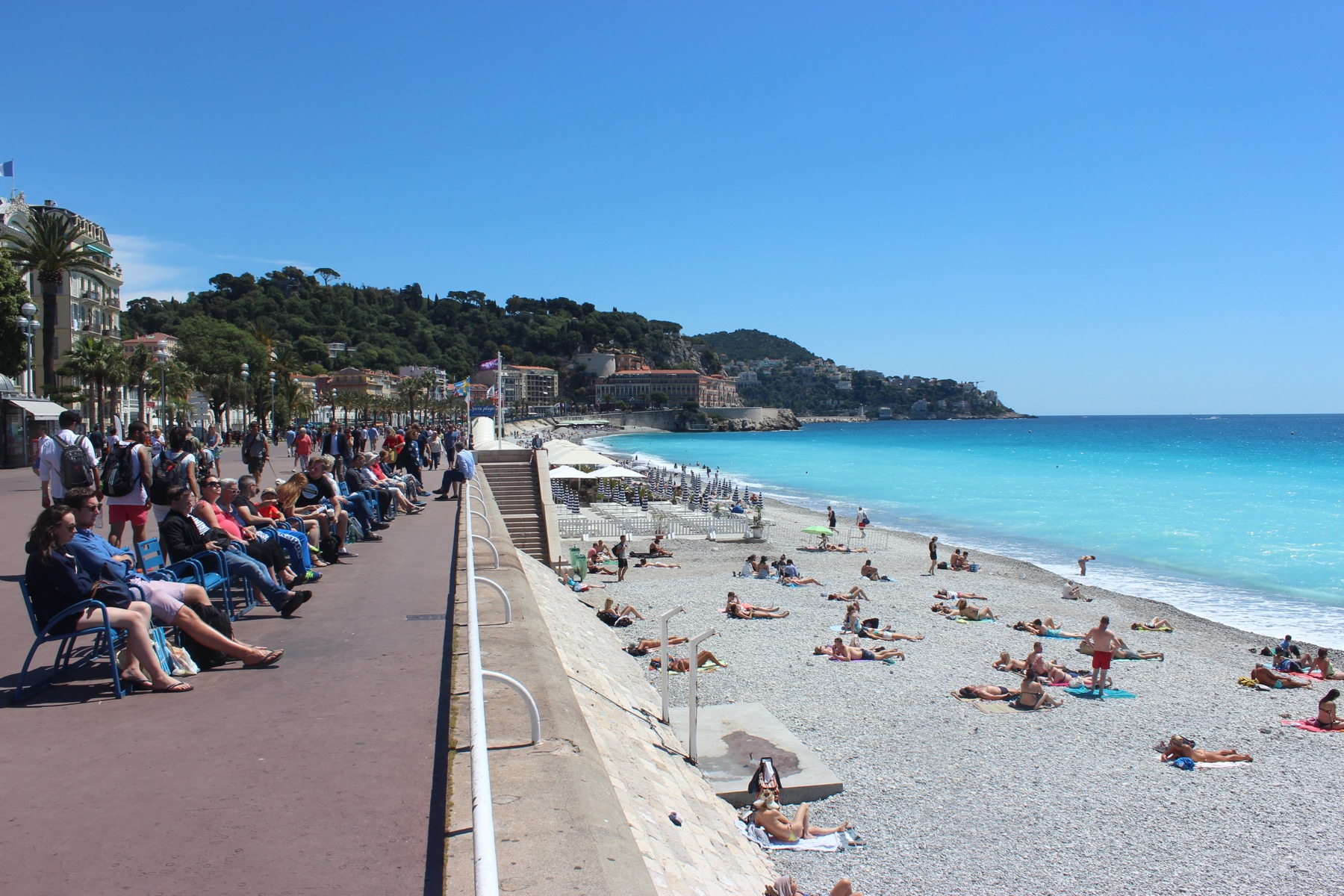
Once you arrive, the first thing that gets you is the Promenade des Anglais. It's the seafront, miles long, with those famous blue chairs facing the water. They call them the "chaises bleues", and they've become the city's symbol: you sit, you look at the Baie des Anges opening in that perfect curve, and you understand why the English came here to spend their winters back in the 1700s. One thing to know and not underestimate: the beach isn't sand, it's pebbles. Big, round, awkward to walk on barefoot. Bring your water shoes if you want a swim, something we on the Ponente coast grasp instantly.
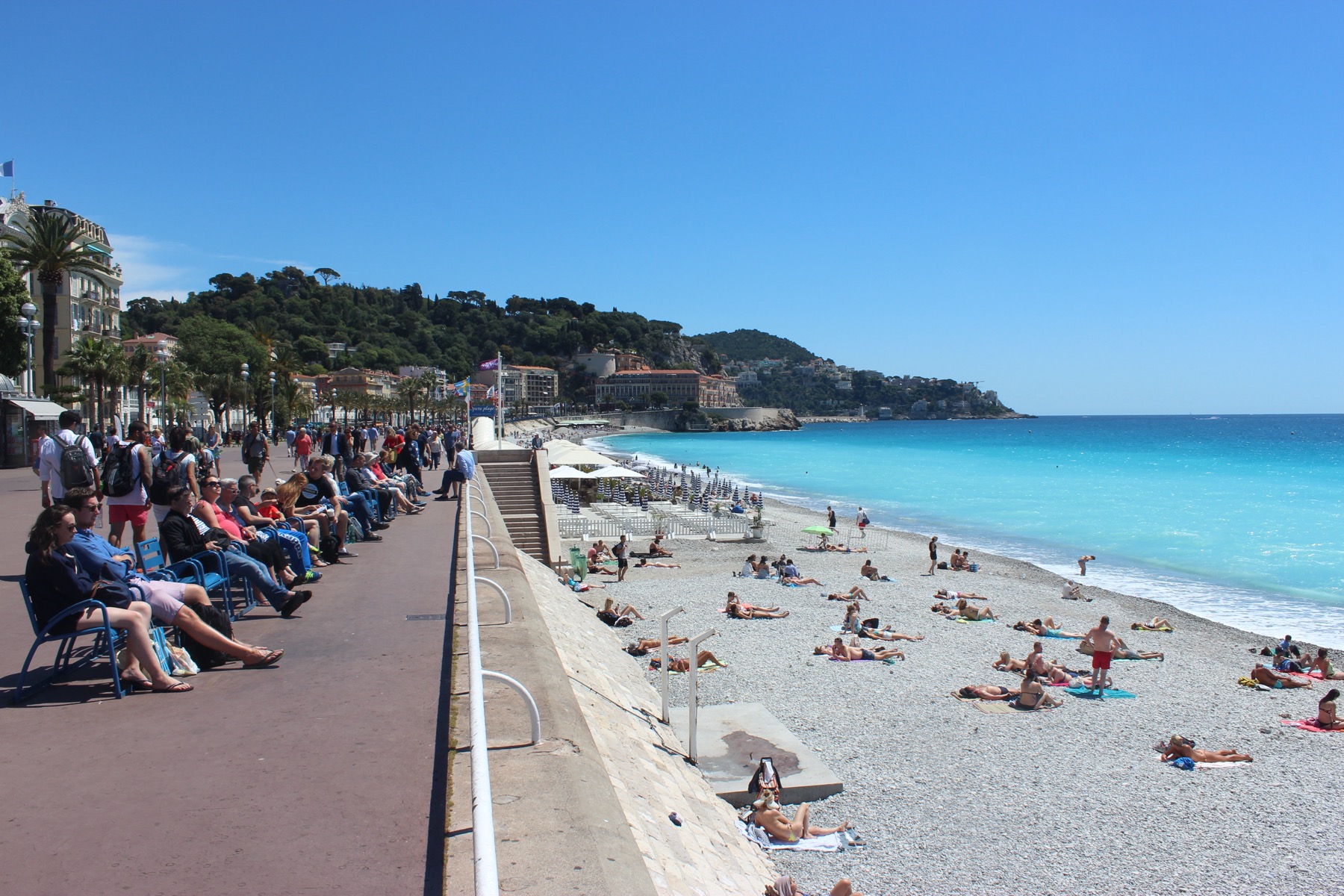 The blue chairs of the Promenade des Anglais looking out over the Baie des Anges and the pebble beach
But then leave the sea and slip into the Vieux Nice, the old town. This is where I feel at home, and I mean it: narrow, tall lanes with washing strung overhead and yellow and red façades, identical in spirit to the alleys of Oneglia, just bigger and louder. You get lost on purpose. You pop out into sudden little squares, find workshops, gelato places, the smell of something frying.
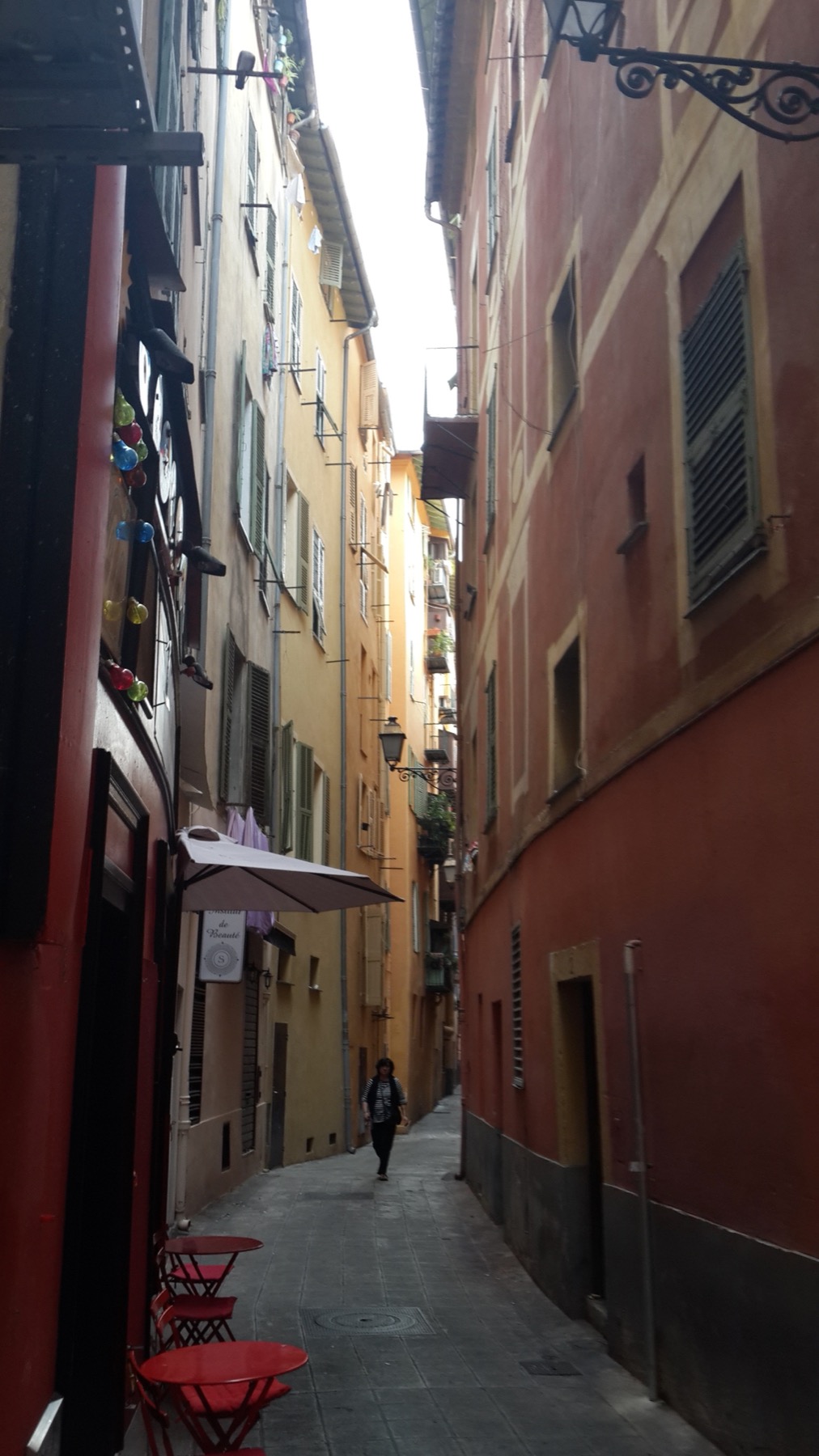 A lane in the old town of Nice, narrow and tall, with yellow and red façades and washing strung overhead
And in the heart of the old town there's the Cours Saleya, the market. In the morning it's a wonder: on one side the food stalls, fruit, vegetables, olives, cheeses, spices; on the other the flower market, which in Nice is an institution and throws up colours you don't expect. It runs Tuesday to Sunday (Sundays it closes early, around lunchtime); on Mondays it changes face and becomes an antiques market, stalls of old things and curiosities. In summer, in the evening, the artisans' stands appear. Knowing this, pick the right day for what you're after.
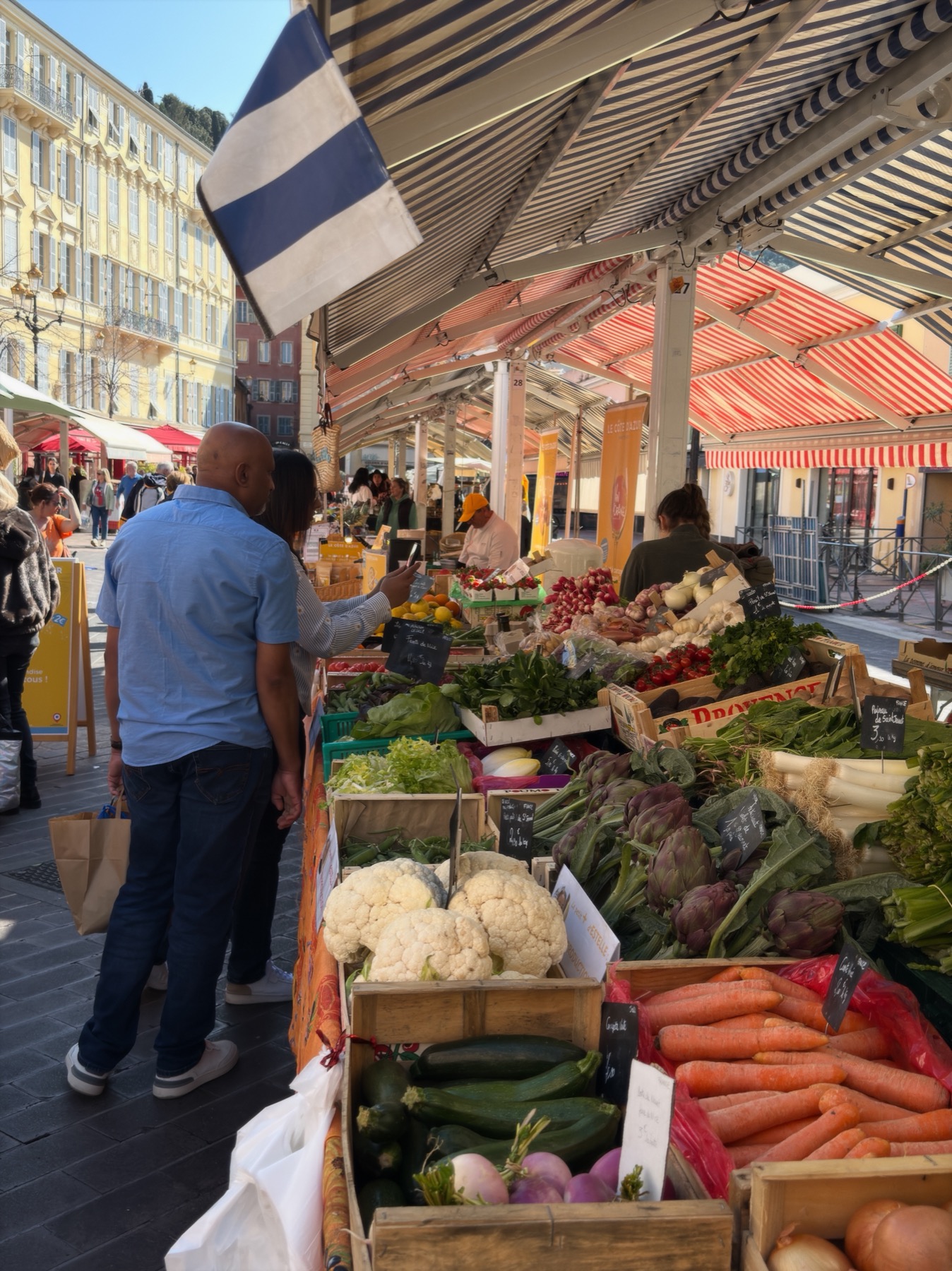 Fruit and vegetable stalls at the Cours Saleya market, under the striped awnings, in the heart of the old town
And here comes the thing I send to anyone who loves our farinata. At the Cours Saleya, and around the old town, you'll find socca. It's a thin sheet of chickpea batter cooked on a big copper pan in a wood-fired oven, crisp outside and soft inside, served piping hot, broken into pieces and peppered. Sound familiar? It should. It's the exact same cousin of our farinata: born from the same Genoese idea, it just changed its name crossing the border. At Chez Thérésa, on the Cours Saleya, they've been making it since 1928, and it costs a few euros a portion. Try it and then tell me it isn't precisely ours, spoken in French. To me it's the proof that the Ponente and the Côte d'Azur are the same land, split by a line on a map.
If you've still got the legs for it, climb the Colline du Château, Castle Hill, at the far end of the old town. Of the actual castle there's almost nothing left, but that's not why you go up: it's for the view. From up there you hold the whole Baie des Anges in one hand, the curve of the Promenade, the red roofs of the old town, and on the other side the port. You can walk up a fine flight of steps, or there's a free lift near the Tour Bellanda that takes you almost to the top without the effort. The park is free and in summer it's open until evening.
And if you stay into the evening — which, given everything I've told you, I can only recommend — the centre of Nice changes its skin. Beyond the beach, the old town and the avenues are full of bars for an aperitivo, often with happy hour, that turn into disco-pubs later on: you go from a drink to a dance floor without moving, and if that's your scene, this is the place. Me, for the early evening, I almost always went for dinner at an Indian restaurant in the centre — the name, I'll admit, escapes me now, but the ritual with Claudio was that: a dinner out of the ordinary, and then out to see where the night ended up.
I owe you the one uncomfortable thing, which is always the same: in summer Nice is packed. Lots of people, queues, blue chairs taken, restaurants full. Go early in the morning, take it slow until the early afternoon, and keep an eye on the clock for the train home. One day is more than enough for the Promenade, the old town, the market, the hill and a socca. The rest, you keep for next time.
Where to find it
- Vieux Nice and the Cours SaleyaThe old town with its narrow lanes and, at its heart, the Cours Saleya market: food and flowers Tuesday to Sunday (Sundays until lunchtime), antiques on Mondays. This is where you find socca, and Chez Thérésa has been making it since 1928.Cours Saleya, Vieux Nice, 06300 Nice
- Promenade des Anglais and the blue chairsThe seafront with the famous chaises bleues facing the Baie des Anges. Pebble beach, not sand: water shoes if you plan to swim.Promenade des Anglais, Nice
- Colline du ChâteauThe hill above the old town, with a view that takes in the whole bay and the port. Free; reach it on foot or by a free lift near the Tour Bellanda. Open until evening in summer.Montée du Château, Nice