There's one thing tourists never imagine when they arrive in Imperia: that Imperia, until a century ago, didn't exist.
There were two towns, and they'd always glared at each other. Oneglia on one side, Porto Maurizio on the other, and a stream in the middle, the Impero, marking the border like a moat. Two different histories, two different temperaments, two football teams you're still better off not naming in the wrong bar.
Then in 1923 someone decided they had to become one.
The decree is dated 21 October 1923. On paper it's signed by the king, Vittorio Emanuele III, but we're in the thick of the Fascist era, and it's the government that wants it. They didn't just merge Oneglia and Porto: eleven municipalities ended up in there, the surrounding villages too, Piani, Caramagna, Costa d'Oneglia, Castelvecchio and the rest. A brand-new town, born with a stamp on it.
And the name? Here's the detail I love to tell. They chose neither Oneglia nor Porto Maurizio, because naming it after one of the two would have meant taking sides. So they took the name of the stream that divided them, the only "neutral" thing they had in common: the Impero. From there, Imperia. A name that back then also sounded patriotic, and that was enough.
Think about it. The town is named after its border. After the line that kept the two halves apart, the line it now had to hold together. More than a love match, it was an arranged marriage, and like all arranged marriages it worked better on paper than in the heart.
Because the rivalry, a hundred years on, is alive and well.
My friends "from Porto" have this sense of superiority that lands on you without their saying a word. You breathe it in. It's a thing of looks, of half-sentences. And every so often they say the sentence in full, laughing but not entirely: "the only beautiful thing about Oneglia is the view you get from Porto". Everyone around here knows it. They pull it out at dinner, at the bar, while you're all enjoying an aperitivo, and as a man from Oneglia you ought to be offended, and instead you laugh, because deep down there's some truth to it, and that makes them enjoy it twice as much.
I've already told you a joke like that when I wrote about San Giovanni: Oneglia's waterfront, for ten months a year, was deserted, and in the evening everyone went to Porto, where the action was. So they did have a kernel of historical truth.
I, in this war, am an odd case. Truth be told, I'm not from Oneglia by birth: I was born in Martina Franca, in Puglia — another incredible place, the kind worth seeing at least once — and I grew up in Oneglia. But by gut I'm Oneglia through and through, it's my town. And yet I never really lived the rivalry. The reason is simple: as a kid I spent half my days in Porto. School was there. The pool was there, and I played water polo in it for years. The beach we went to in summer, often, was over there too. Half of Imperia shuttled back and forth across the bridge over the Impero without even thinking about it, and I was one of them.
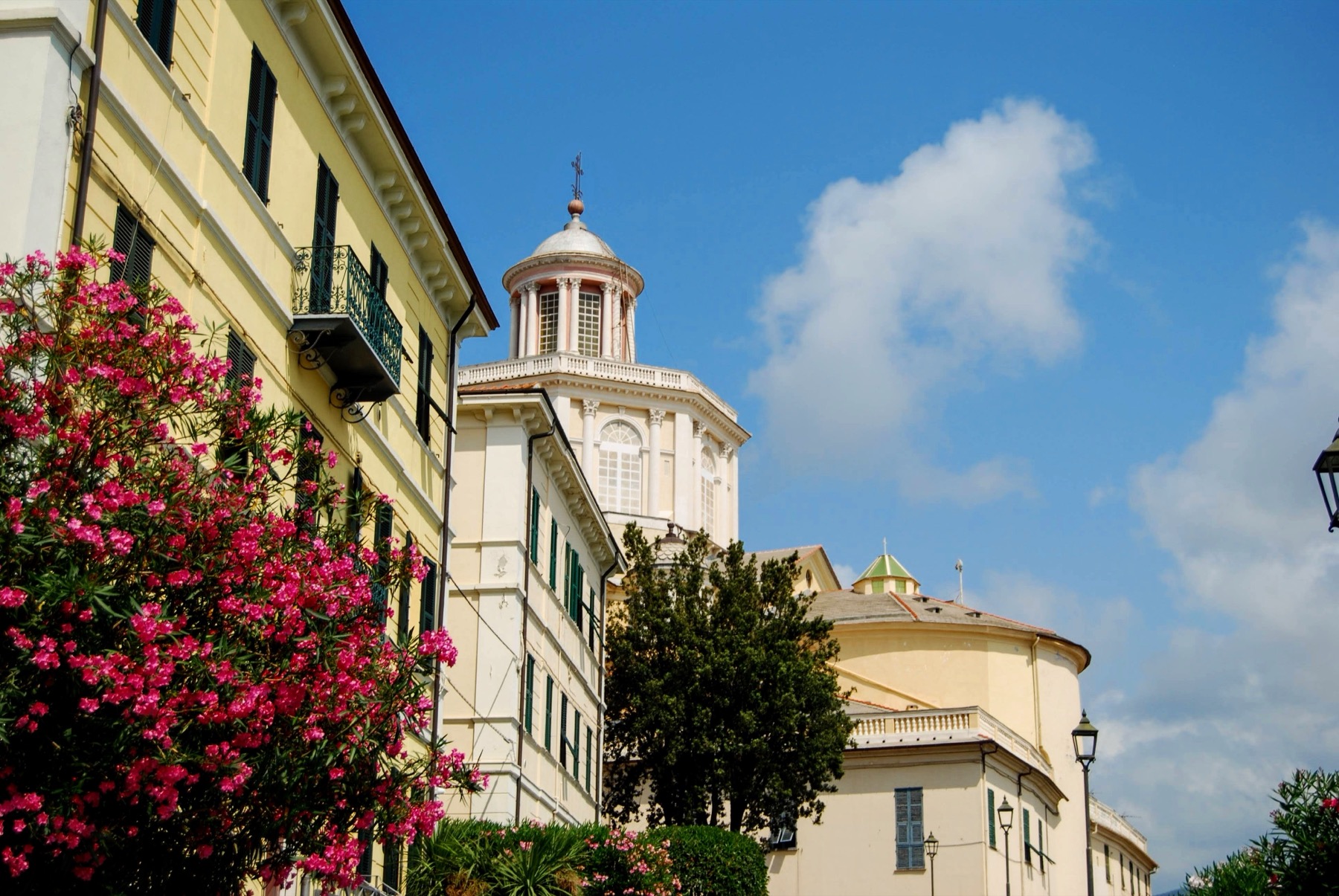
So I grew up with one foot on each side. A man from Oneglia who watches the rivalry from the inside, but as a neutral, like someone with relatives in both families who at Christmas doesn't know which side to take. I defend Oneglia because it's home, but I'm happy in Porto, and when I climb up to the Parasio in the evening, with those caruggi spiralling up to the Duomo and the sea peeping out at every turn, I have to admit it: as an old town, Porto Maurizio holds its own. In fact, it wins. There, I've written it, and someone in Oneglia won't forgive me.
Because in the end they're two different things, and that's the beauty of it. Oneglia is trade, olive oil, the fishermen's harbour, the straight arcades the House of Savoy built on the Turin model, the market shutters going up at dawn. It's a working town, earthy, real. Porto Maurizio is the village that looks down on the sea from above, the noble houses, the medieval Parasio, the largest church in Liguria planted on top like a crown. Porto is prettier on a postcard. Oneglia is better to live in. Or at least, that's what we say.
And then there's the new generation, which has clear ideas and doesn't ask itself too many questions.
My daughter Emma, on this matter, has no doubts. For her Oneglia wins hands down, end of discussion. And it's not just talk: when we decided to buy a house in Imperia, she didn't hesitate for a second — she wanted it in Oneglia. And when Emma makes up her mind, there's not much you can do. I didn't teach her that, mind you: it's her own, she chose it. It's Piazza San Giovanni with the market and the bread, it's the waterfront we walk down in the evening, it's her idea of home. You mention Porto to her and she shrugs: nice, sure, but Oneglia is Oneglia.
And maybe that's how it should be. Towns are decided by the people who live in them, not by the decrees of 1923. Mussolini may well have merged the municipalities and invented a name, but he never managed to merge people's hearts, and thank goodness. Oneglia stays Oneglia, Porto stays Porto, and between them the Impero still flows, still dividing and uniting at the same time, exactly as it always has.
When you come, take a walk through both. And here's your advantage: we people of Imperia are doomed to pick a side, you're not. You get to enjoy both, guilt-free. Go down to the waterfront in Oneglia for the fish and the aperitivo, and climb up to the Parasio in Porto to lose yourself in the caruggi at sunset. Then, in the end, you make up your own mind about who wins — or you don't, which may be the smartest move of all. I've got mine, but I listen to Emma: hands down, Oneglia.
Where to find it
- The Parasio (Porto Maurizio)Porto's medieval old town, a maze of caruggi that climbs in a spiral up to the Duomo di San Maurizio, the largest church in Liguria. Almost entirely pedestrian, with sea views at every turn. The most beautiful thing in Porto, and that's a man from Oneglia talking.Parasio, Porto Maurizio (Imperia)