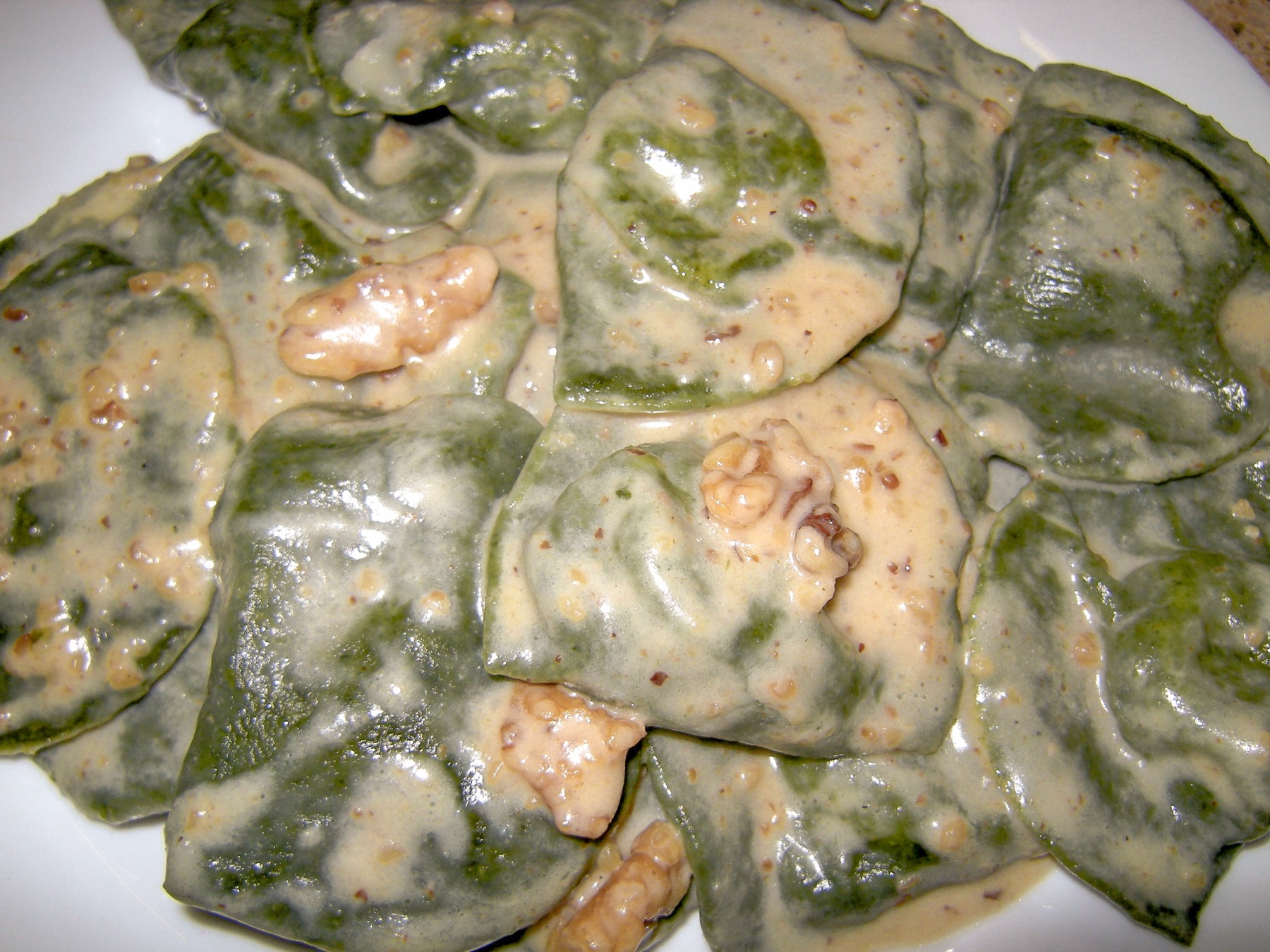
There's a smell that, if I close my eyes, takes me straight back to Oneglia on a Saturday morning: boiled greens and a soffritto on the stove. It's the smell of ravioli filling, and to me it isn't the scent of a restaurant. It's the scent of a little shop in Piazza San Giovanni, and of my daughter Emma holding my hand while we wait our turn.
Let's start with the dish, though, because it deserves it.
Ravioli di magro are one of the pillars of Ligurian cooking, and "di magro" means something precise: no meat inside. The filling is green. The queen is borage, a wild herb that has always been gathered here and has a delicate, almost cucumber-like flavor; alongside it go chard, spinach, sometimes a mix of field herbs that around here they call preboggion. You boil it all, squeeze out every last drop, chop it fine, and bind it with ricotta, Parmigiano, an egg and a grating of marjoram. Marjoram, here, isn't a detail: it's the herb that says "Liguria" more than any other.
Then there's the dressing, and on this one families split. Some want them with butter and sage, which is the cleanest way to eat them: butter melted slowly, a few sage leaves, a snowfall of Parmigiano, and the filling speaks for itself. And some want them with tomato, a simple sauce and nothing more. In my house, growing up, ravioli with tomato won on Sundays; butter and sage was the special-occasion version. I'll tell you the truth: there is no right one. There's your grandmother's one, and that one always wins.
And here we get to the part I care about most.
In Oneglia, you don't have to make the ravioli yourself. You buy them, fresh, from the pasta maker. And it's not a lazy shortcut: this is exactly how it's done, and always has been, in a town where fresh pasta is a craft and not a fallback. The place is the one everybody knows: the historic shop in Piazza San Giovanni, next to the church, going since 1954. You walk in and you find ravioli just sealed, gnocchi, tagliatelle, ready sauces; and behind the counter someone rolling the dough as thin as it should be. One small heads-up, so you don't order the wrong thing: the ravioli all'onegliese, the house specialty, have greens inside but also sausage, so they aren't "di magro." If you want them meatless, ask specifically for the ravioli di magro, or the borage ones. They wrap them up, you carry them home, and in five minutes of boiling water you've got a dinner that looks like it took someone hours.
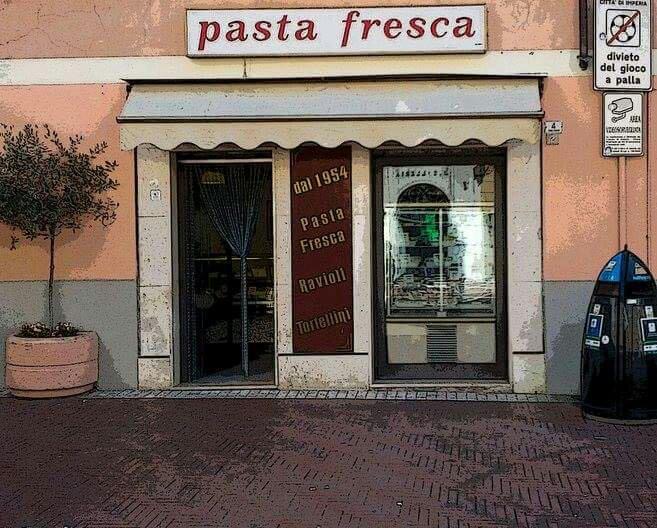 Pasta Fresca U Fratin's shop in Piazza San Giovanni, Oneglia, open since 1954.
Now the memory, because without it this would just be a recipe.
For Emma's first years, Saturday in Oneglia had a fixed script. We'd come down to Imperia to visit nonna Stella, and Piazza San Giovanni was the first stop. It's the church square, the heart of Oneglia: the bakery is there, the market is there, and the pasta maker is there. We'd buy the pasta "for grandma," the way you buy the bread "for grandma," which was really a gentle way of saying that was Emma's pasta. She'd choose, point her finger at the ravioli behind the glass, and feel grown-up doing the shopping for her family. It's the exact same ritual as the bread from Blengini, a few steps away: same square, same hand in mine, same grandmother waiting at home.
And it's funny how kids work. At the table, Emma fights vegetables one by one. But faced with a raviolo di magro, where the borage and the chard are hidden inside the dough, she doesn't blink: she eats, and asks for seconds. She's eaten the greens all right, she just doesn't know it. Sometimes a raviolo does what a plate of vegetables couldn't even dream of.
If you decide to make them at home, don't be scared: the real work is one thing only, and it's squeezing the greens. They have to be squeezed seriously, until nothing more comes out, because water is enemy number one: it soaks the filling and pops the ravioli open in the pot. Everything else is just gesture and patience. Roll the dough thin, make the little mounds of filling, cover, press well all around to chase out the air, and cut. They won't come out as perfect as the pasta maker's: they'll come out yours, and that's better.
A word on the season. Real borage is a spring and early-summer thing; later on you find it less, and it's perfectly fine to make do with chard and spinach, which are around all year. For the green and the sweetness the result holds up; and honestly, inside a raviolo dressed with butter, only someone hunting for the difference will find it.
And the oil? In butter ravioli you don't need it, but if you go with tomato or walnut sauce, a thread of good raw oil at the end changes everything. If you're here on holiday and don't know where to get the real stuff, I've already told you: you go to the frantoio, and you buy it by the tin.
Whether you make them or buy them, in the end the dish is the same: green inside, simple on top, and that taste of home that in Oneglia gets handed down Saturday after Saturday. For me, even today, the smell of greens on the stove is all it takes to have my daughter back at five years old, and a whole square in front of me.
- 1The dough: knead flour and eggs until smooth, wrap it and let it rest for half an hour.
- 2Boil the borage and chard, squeeze them out very well (water is the enemy of the filling) and chop them finely.
- 3Mix the greens with the ricotta, the Parmigiano, the egg, a good grating of marjoram, salt and a little nutmeg.
- 4Roll the dough thin. Place little mounds of filling, cover with a second sheet, press well all around to chase out the air, and cut out the ravioli.
- 5Cook them in salted boiling water for about 5 minutes, until they float.
- 6Dress with melted butter and sage, and a shower of Parmigiano. Or with a simple tomato sauce.
Where to find it
- The historic pasta maker of Oneglia, next to the church, since 1954. Ravioli di magro and ravioli all'onegliese (these last ones filled with greens and sausage), gnocchi, tagliatelle, sauces. The dough rolled thin on request.Piazza San Giovanni 4, Oneglia (Imperia)