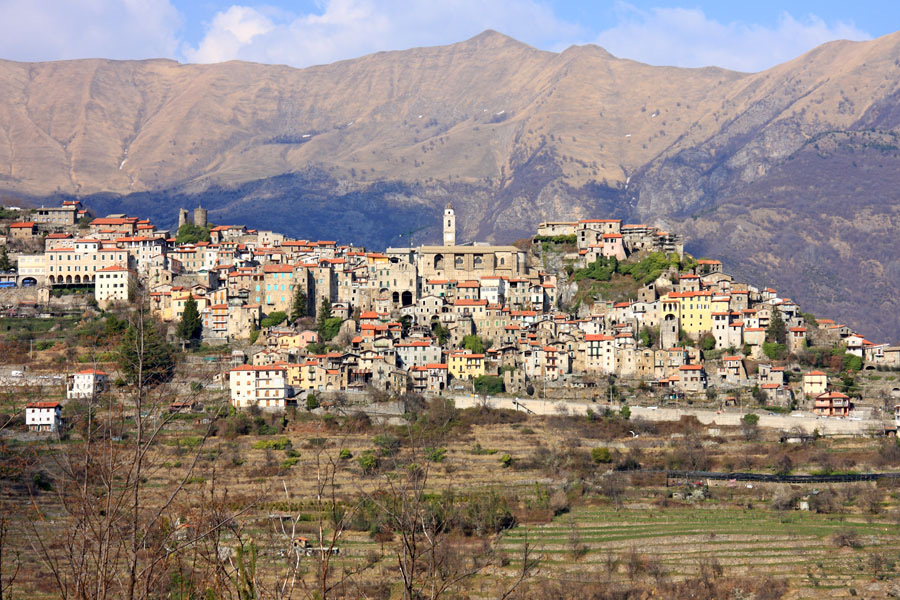
There's a village, deep in the Argentina Valley, that has always mattered more than its forgotten-place air would suggest. Triora was the granary of the Republic of Genoa: the grain grown on these mountains fed a sea city days away by mule track, and to defend it Genoa ringed the village with walls and five fortresses. A handful of souls at the end of the world, but rich and armed like a small capital. A place like that, History never leaves in peace: it marked it with suspicion, with fire and with blood, more than once.
Triora isn't a trip to make half-heartedly. It's fifty minutes of hairpin bends climbing up the Argentina Valley, the inland country that separates Imperia from Sanremo, and by the time you arrive you're at nearly 800 metres, with the Ligurian Alps closing off the horizon. The first time I drove up was in autumn, with a friend, and I remember it because down on the coast it was twenty degrees and up there we were turning up our collars. That alone should tell you what kind of place this is: not the Liguria of palm trees and beaches, but something else, proper mountain country.
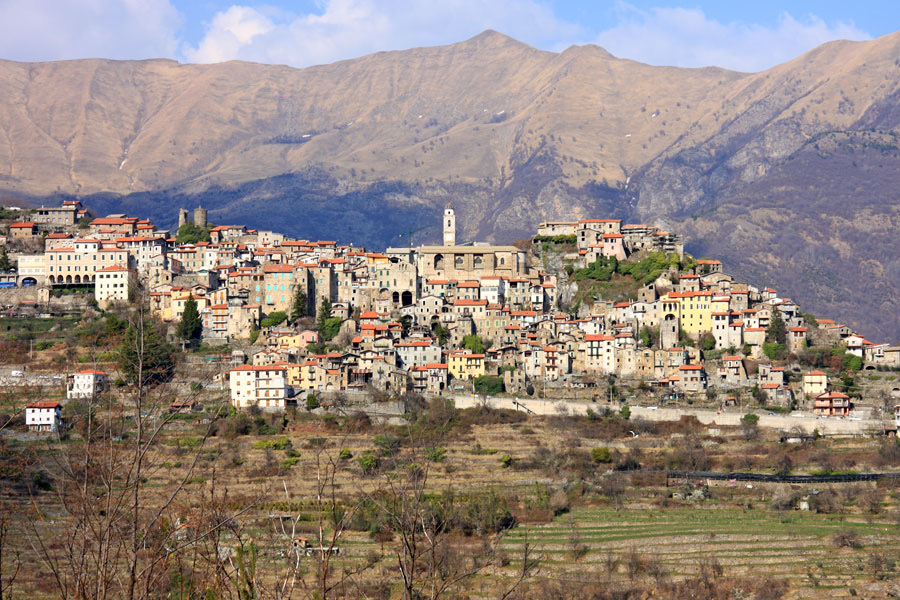 The village of Triora clinging to the high Argentina Valley, its slate roofs huddled below the bare Ligurian Alps
You know Triora's reputation even if you've never been: the village of the witches. The real history is as grim as the village itself. Between 1587 and 1589 the valley had been worn down by two years of famine, and people began to blame a group of women accused of witchcraft. More than thirty were arrested within a few months, interrogated, tortured. The whole thing swelled to the point that the Inquisitor of Genoa had to step in from above, in the autumn of 1588, and the accused ended up transferred to Genoa. The trial closed around 23 April 1589, and the final sentences between 1589 and 1590 were, in the end, lenient — recantations, penances, a few releases — but by then women had been broken, and some never came back. Films, books and legends have grown out of it; but when you walk the alleys it's worth remembering that behind the tourist brand there was a hunt for women, and a famine that was killing people.
And there's a second wound, more recent, that few tourists connect with Triora. On 2 July 1944 the Germans came up here on a reprisal: they marked the doors of the houses with a black incendiary liquid, set boxes of TNT against the foundations, and put the village to the torch. In two days they razed three of the six quarters — Poggio, Cima and Carriera. The village never fully recovered from that destruction, and it's partly because of that fire that so few people live in Triora today. You can still read it, walking around: the houses thrown up quickly after the war, beside the medieval ones that survived.
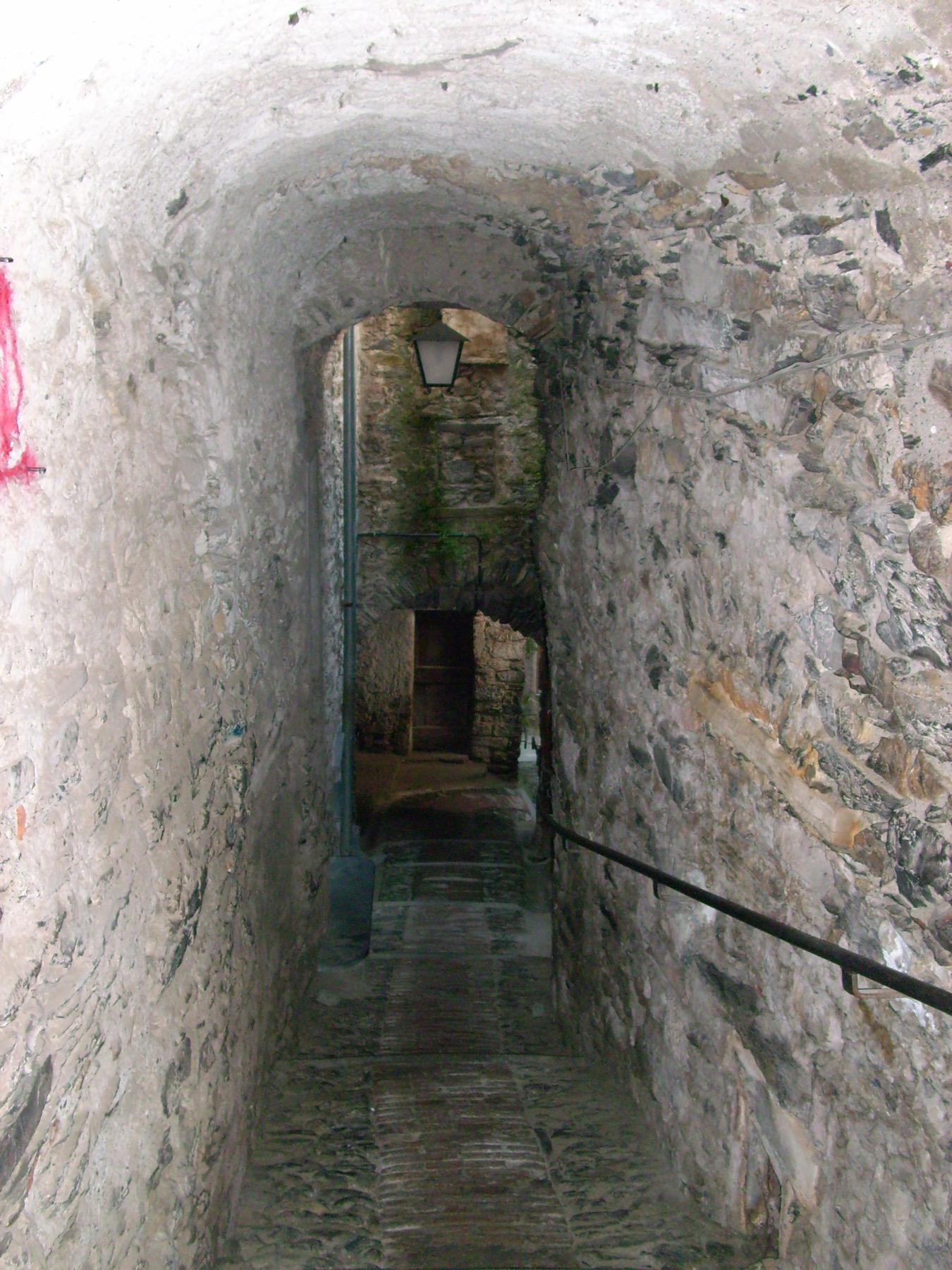 A covered passage in rough stone, with a lantern and steps dropping toward an old wooden door: Triora stays in shadow even by day
The village is worth it precisely because of this: it's authentic, not done up as a theme. The alleys are narrow and steep, often covered, with arches bridging the lanes and dark stone doorways carved with dates three or four hundred years old. In places, even in daylight, you find yourself in shadow, and in winter, or with the fog rising from the valley, the effect is exactly what you'd imagine. It isn't a cheerful place, and that's exactly why it's worth visiting: it has character. There's also the Cabotina, the ruin on the edge of the village where tradition says the supposed witches lived, and the remains of the castle at the top. One practical warning: you walk a lot, up and down on cobblestones, and when it rains they get slippery. Comfortable shoes, not your beach sandals.
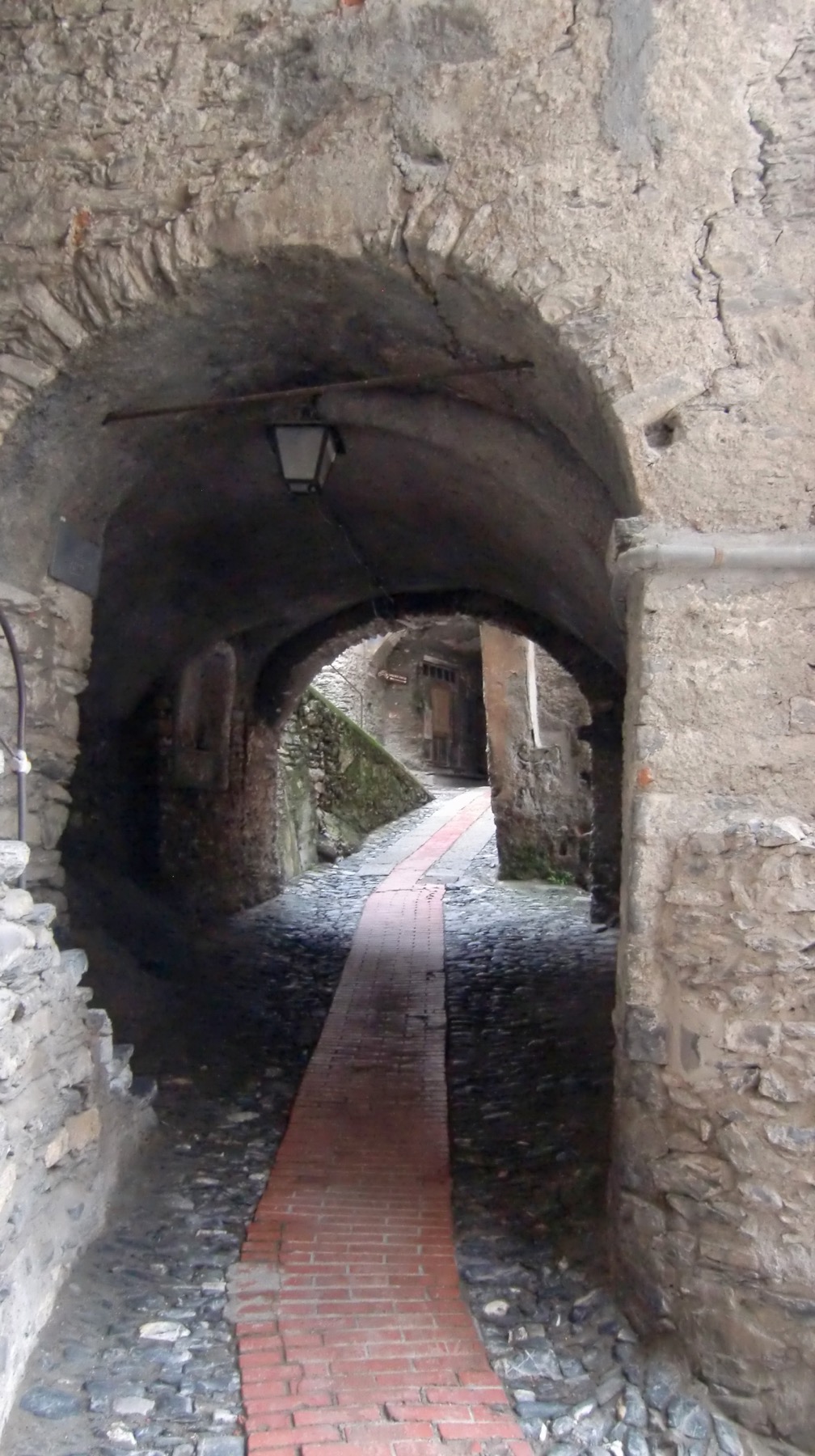 An alley vaulted over with stone, arches bridging the lane above the cobbled paving
The stop that ties it all together is the Ethnographic and Witchcraft Museum, open since 1983 in the cellars of the former prison. The ticket costs a few euros and it isn't a theme park with special effects: the witchcraft part is told through documents and reconstructions, but half the museum is given over to the valley's rural life — the tools, the kitchen, the work in the fields and the woods. It's the key to understanding where you are: before it was the village of the witches, Triora was a village of hunger, hard work and grain. Check the opening hours before you set off, because it's open every afternoon but only on holidays in the morning, and it would be a shame to drive all those bends and find it shut.
And here we get to the reason I happily go back to Triora even just for half a day: you eat well and you buy serious things. The bread of Triora is one of those things hard to explain to someone who hasn't seen it. They're low, wide, dark loaves, made with type 1 flour and a little buckwheat, slowly leavened and once baked in the village's communal oven — the Vico del Forno is still there, where each family used to bring its dough to bake once a week. Triora was the granary of the Republic of Genoa, and this bread is the living remnant of that history. The crust is thick and crunchy, scored with a square pattern on top, and the inside is dense. What makes it special for someone on holiday is mundane but true: it keeps for days. A loaf will last a good week without becoming inedible — in fact the next day it's even better. Buy it in the village, from the bakery, not at a supermarket on the coast.
The pairing I'd suggest is the one they've always made up here: bread of Triora and bruzzo (you'll also see it written bruss or brussu). It's ricotta — sheep, goat or cow — left to ferment in its jars in a cool place, turned over day after day from the bottom up, until it becomes creamy and very strong, turning spicy with ageing. It's not for every palate, I'll say that honestly: the first spoonful throws you. But spread on a slice of that bread, with a glass of red, it's the taste of the valley in a single bite. If you like the idea of going home with something real, this and a loaf are worth the trip more than any souvenir.
One last practical thing. Triora is deep inland: services are few, some places may be closed on weekdays in low season, and the road is lovely but demanding. If, on the way down, you pair it with the lower part of the valley — Badalucco, Molini di Triora — you've got a full day. But even Triora on its own, the museum and the bread, is one of those trips that stays with you. If you're after more of the inland country around here, I write about it in where to eat inland too.
Where to find it
- Triora (village)The medieval village perched in the high Argentina Valley: covered alleys, stone doorways, the Cabotina and the castle ruins. Lots of steep walking, wear comfortable shoes.Triora (IM), high Argentina Valley
- Since 1983 in the cellars of the former prison: the 1587-1589 trials told through documents, plus a fine section on the valley's rural life. A few euros, open afternoons (mornings only on holidays). Check the hours first.
- Bread of TrioraLow, dark loaves (type 1 flour + buckwheat), crunchy crust, keeps for a week. Buy it from the bakery in the village. Try it spread with bruzzo, the local fermented ricotta.