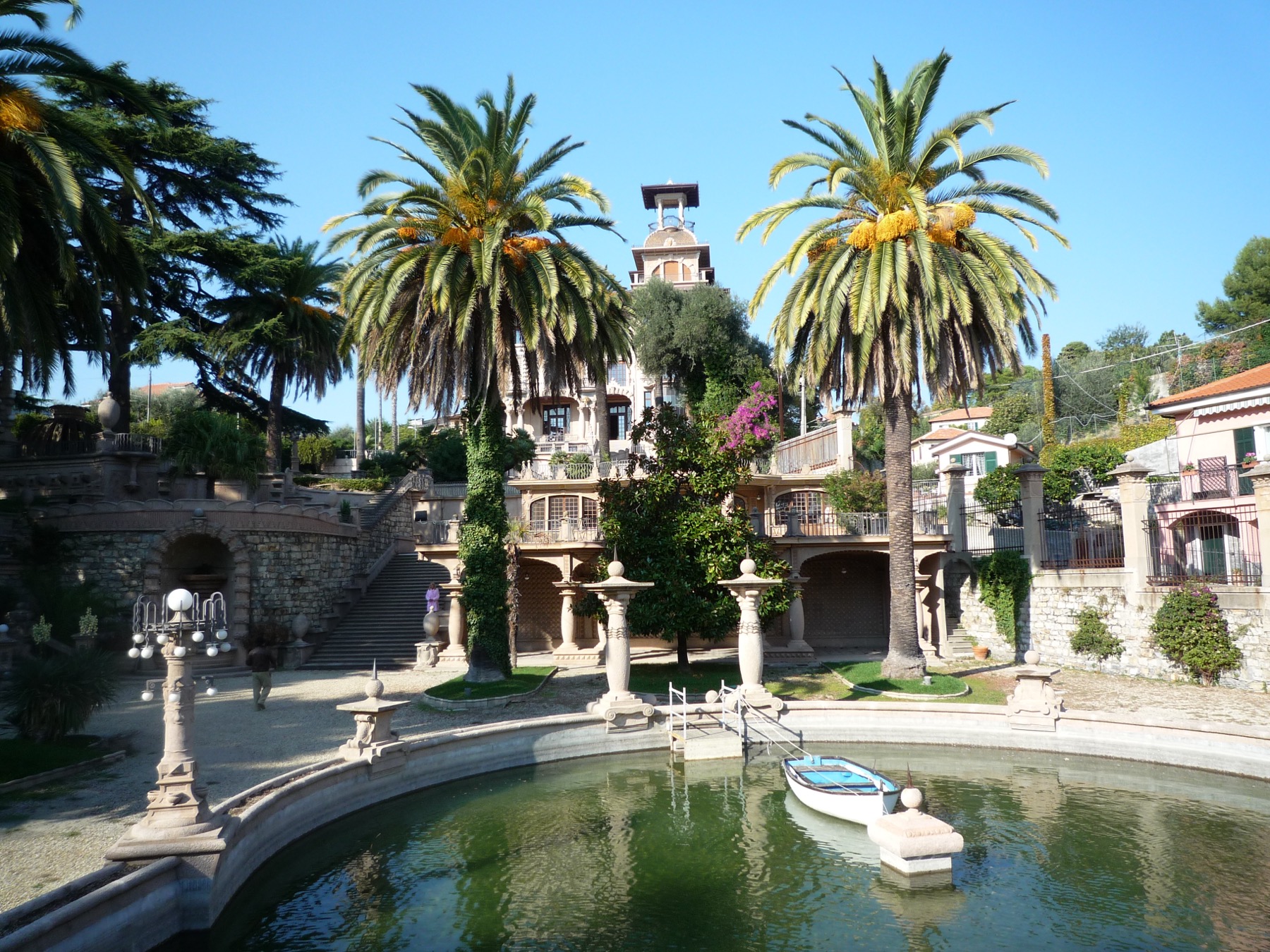
If you climb the hill that looks down on the sea from Oneglia, at some point, on Via Fanny Roncati Carli, you come across a house that resembles nothing else around. Mascarons staring at you from the walls, staircases that seem built for making an entrance, columns, arches, a little lake with a temple in the middle of it. The first time you see it you think it's a joke, or a film set. Instead it's a real house, and the man who wanted it this way was a clown.
Grock's real name was Charles Adrien Wettach. He was Swiss, born in Reconvilier in 1880. For years he was the highest-paid performer in Europe, and they called him the king of clowns: he made people laugh with the violin held the wrong way round and his disasters at the piano, an act that toured theatres across half the world. He first came to Imperia in 1920 because of his wife's relatives, and he liked the area enough to settle here. First he had a smaller house built, Villa Bianca, then in 1927 he bought a triangular plot up here and started the big project: three floors, something like forty-seven rooms. He moved in around 1930 and stayed to the end: he died right here, in Imperia, in 1959.
The lovely thing is that the villa is his own idea. The technical drawings were signed by a Genoese surveyor, Armando Brignole, but the oddball ideas are all Grock's. The style is Liberty pushed to excess, mixed with Art Deco and oriental, Persian, slightly Baroque touches: a jumble that from anyone else would be kitsch, and from him, instead, works. He modelled the mascarons himself, drew graffiti on the walls, redid things until he liked them. And then there are the symbols: clowns' balls, masks, references to the circus, and nods to astrology and astronomy, because he cared about those things.
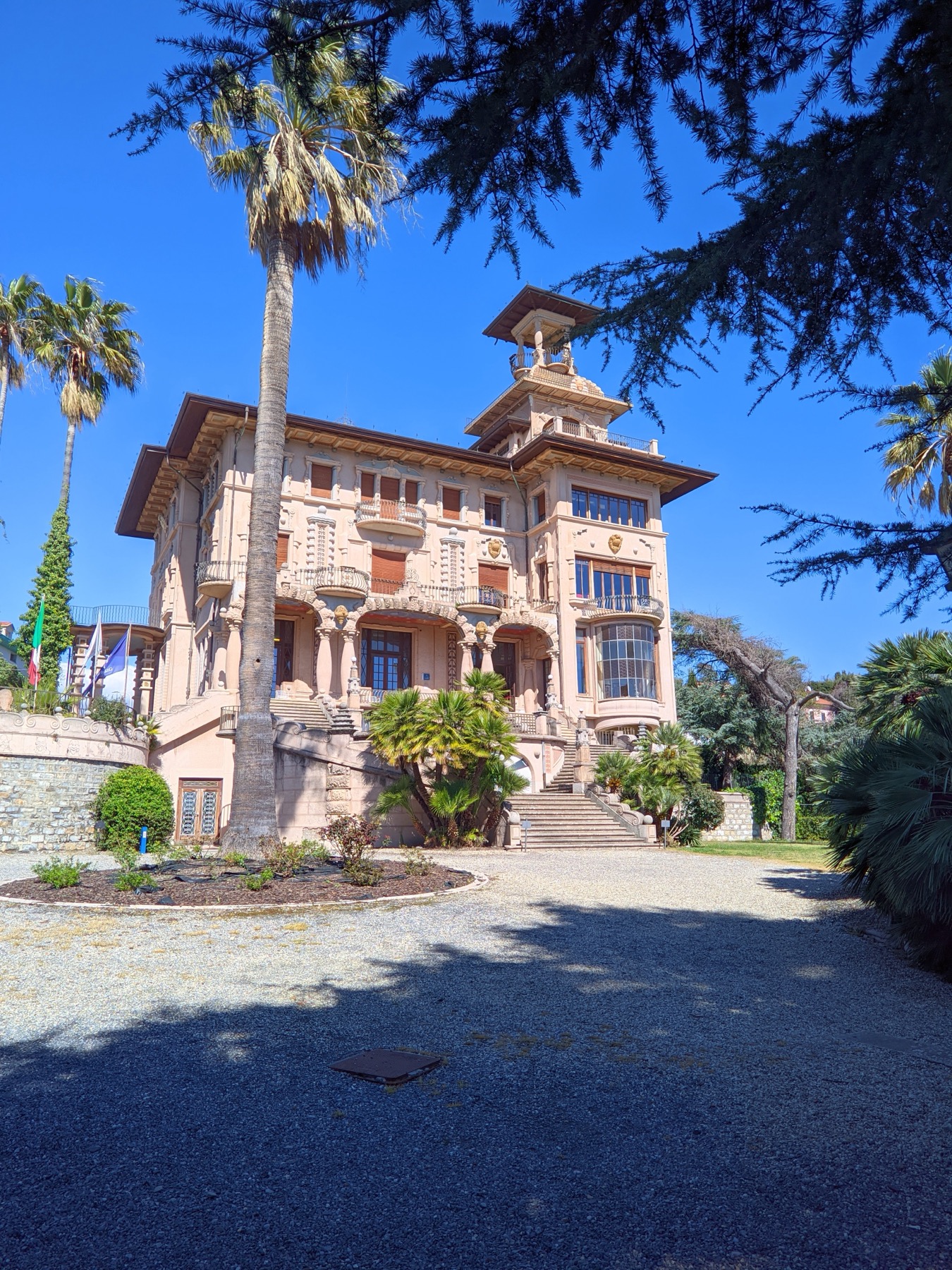 The theatrical facade of Villa Grock, with the belvedere turret and the entrance staircase.
The part that stays with you most, especially with children, is the park. In front of the house there's an elliptical pond, a sort of fish basin, and in the middle a little island with a temple held up by spindle-shaped columns and topped by a small dome. To reach it you cross a little bridge with a low, flattened arch. They say Grock fished there and even dived in. Around it, what's left of a garden that was once enormous, seven thousand square metres before part of the land was sold off: Lebanese cedars, firs, magnolias, palms, cycads, olive trees. You walk through it and you realise the strangeness isn't only in the walls, it's in the air.
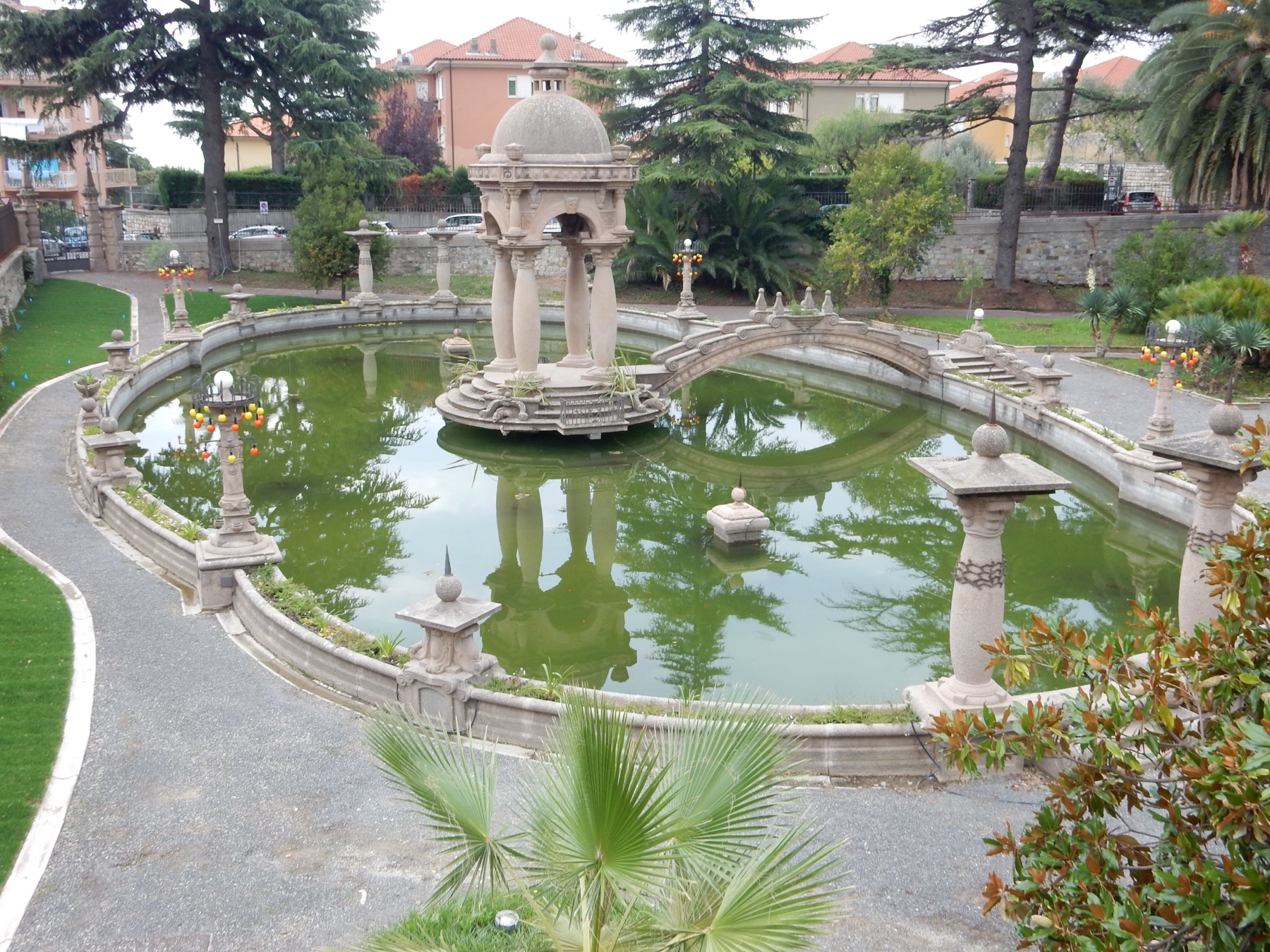 The elliptical pond with the little columned temple in the middle and the low-arched bridge.
For years the villa sat abandoned, and it wouldn't have taken much for it to end badly. Then in 2002 the Province took it over, and after a long restoration it reopened in 2013 as the Clown Museum. Inside there are Grock's belongings and some playful installations; outside there's the park to wander, and in summer they run workshops for the little ones. The ticket costs a few euros, with a reduced rate for kids and free entry for small children; the hours change quite a bit between summer and winter, so before heading up it's worth checking the museum's website, also because on opening days there's a shuttle from the centre that saves you hunting for parking on the hill.
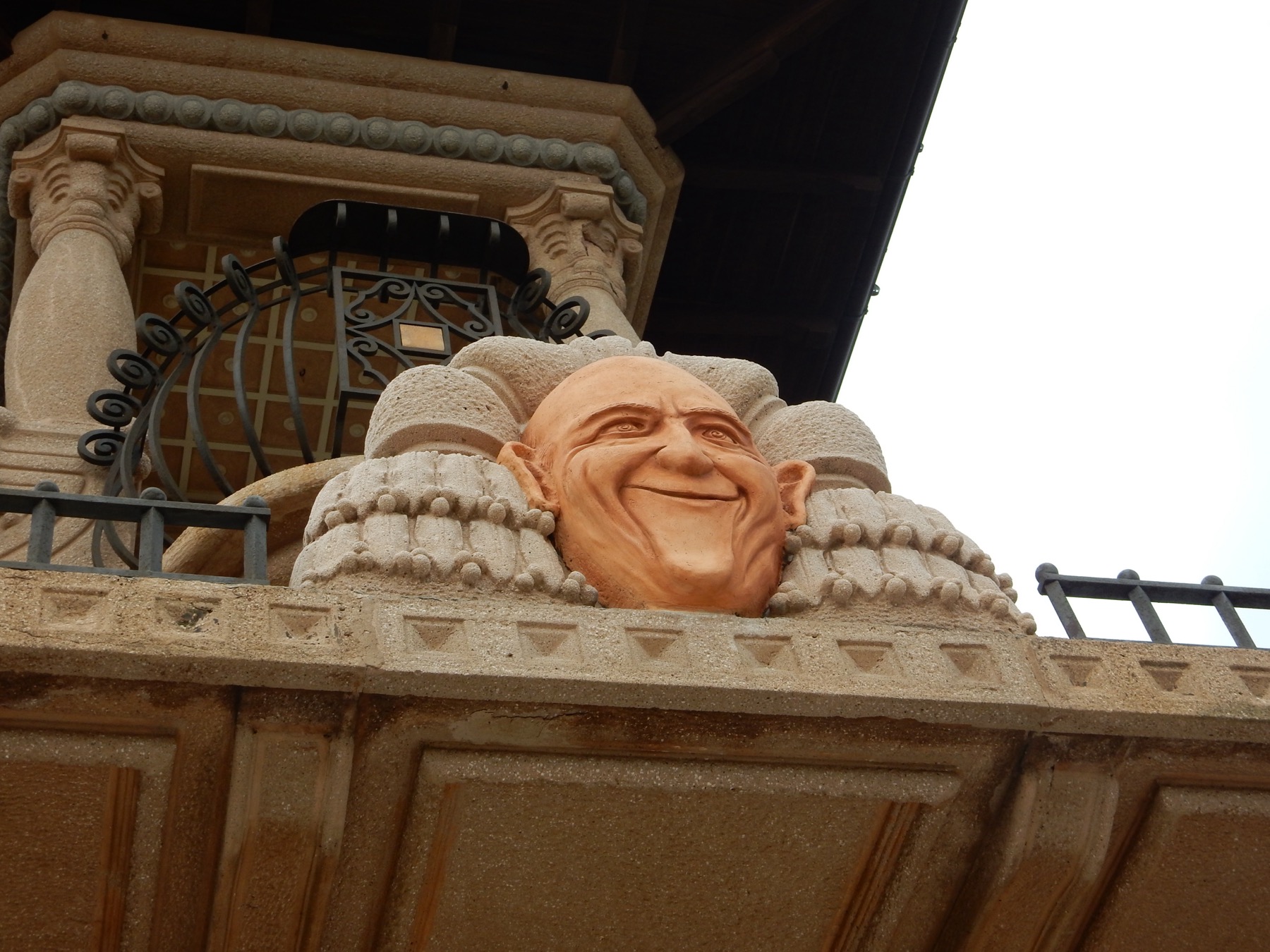 One of the mascarons peering out from the villa's walls: the smiling face of a clown.
I got to know that villa, though, long before it became a museum. All this has only been restored in recent years: when I was a kid, Villa Grock was shut and abandoned. And I'd spend certain bored afternoons with Denis, a schoolmate from middle school, climbing over the gate and sneaking in. We played undisturbed in the park left to itself, among the staircases and the empty pond, and every time we'd end up scrambling all the way up to pop out on the belvedere turret, with the whole of Imperia under our feet. If my mother had known, she'd have killed me. Today, maybe, I'd get away with a smile.
And here I come to the part that matters most to me. For my Emma, when she was little, Villa Grock wasn't the museum, or the lake, or the mascarons. Villa Grock was Santa's house. Around the holidays the villa really does dress up and he turns up, in the flesh, to collect the children's letters. I'm not making this up as a tourist gimmick: it's something they've done for years, I've seen it with my own eyes and found it in the local papers too. For Emma the whole ritual was in writing that letter. She'd think it over for days, copy it out neatly, decide and change her mind about what to ask for. Then we'd post it there, and from that moment on, for her, Christmas had officially begun. I still remember the face she made handing over that scrap of paper, somewhere between dead serious and thrilled.
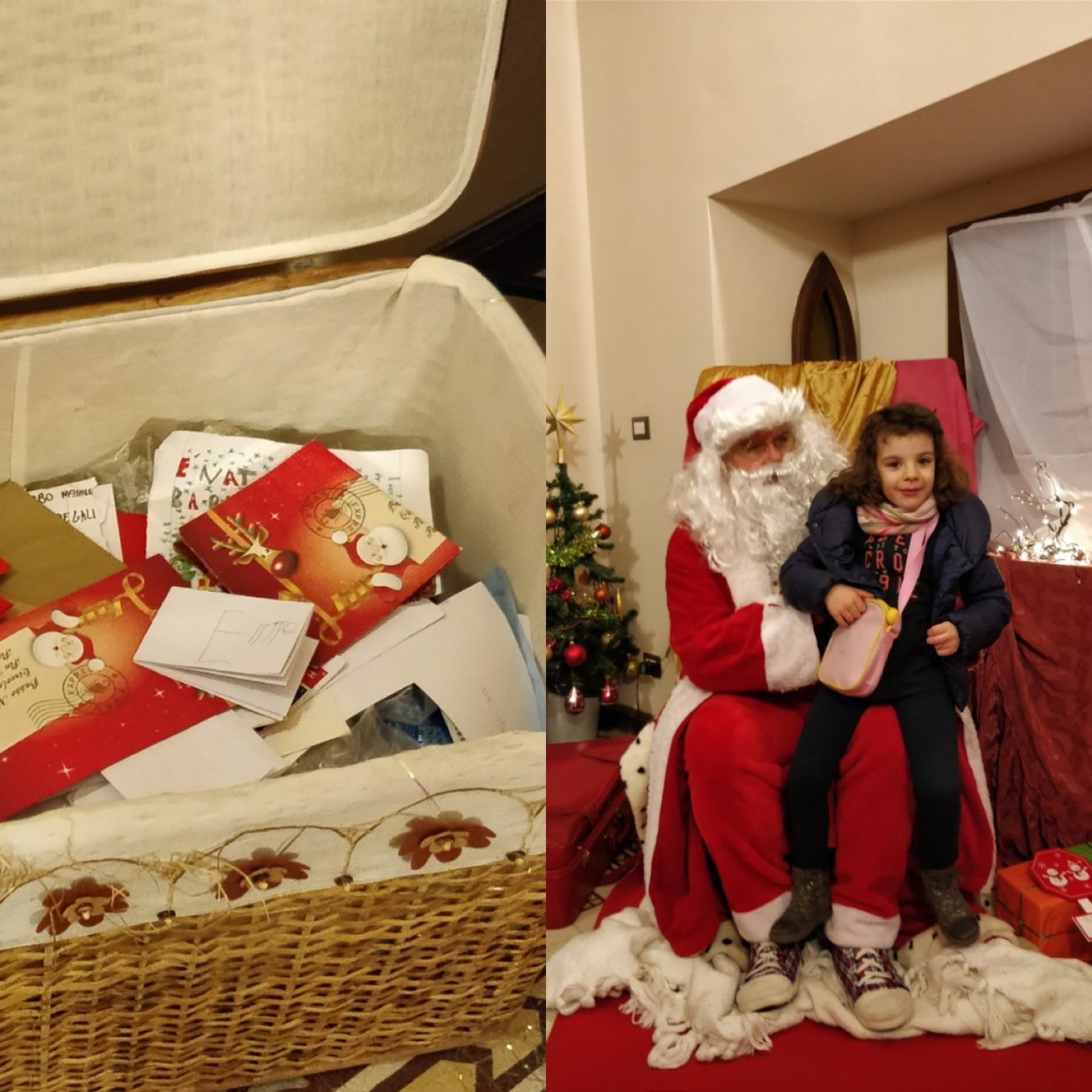 Emma leaving her letter to Santa, at Villa Grock.
And you know what got to me? That bringing her there was, for me, a small handing-over of the baton. In the very place where as a kid I used to climb the gate of a dead villa, years later I was holding my daughter's hand as she posted her letter to Santa, in a villa brought back to life. The same stone, two different childhoods, and in between a town that won back a piece of itself.
That's why, when I recommend Villa Grock, I do it in two different ways. If you're travelling in summer, it's a strange and lovely stop, a circus story looking out over the sea, and I put it among the places for families around here (I talk about it in Green Imperia, ideas for families). If instead you happen to be here around Christmas with children, then go up for the letters, trust me. It's a place that plays for real, just like the man of the house used to.
Where to find it
- The eccentric villa of the clown Grock, now a civic museum with a park and a little lake; workshops for children in summer and, around Christmas, Santa collecting the letters. A few euros to get in, reduced for kids, free for small children: up-to-date hours and prices on the museum's website.Via Fanny Roncati Carli, Oneglia, Imperia