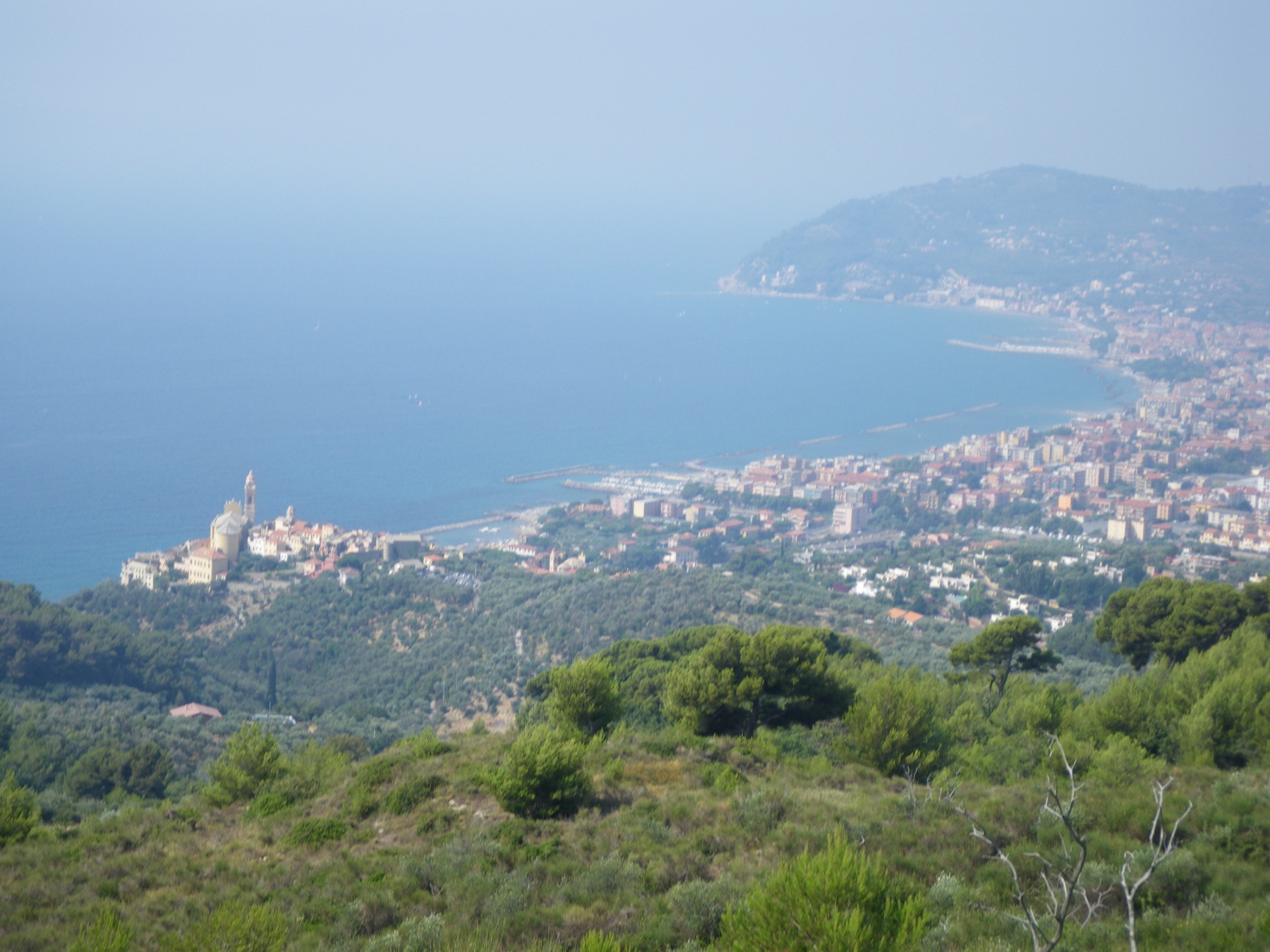
Monte Calvario isn't a tourist spot, and maybe that's exactly why I'm fond of it: no plaques, no tickets, few people who even know it. And yet it's one of those places that, if you climb up, leave something inside you. When I was a kid and someone asked "where do you see Imperia from above?", the answer was always the same: Monte Calvario. It's a small isolated hill just west of Porto Maurizio, and for my parents it was the Sunday-morning outing on days when the sea was too cold for the beach. As a teenager, then, I used to ride up to the Calvario on my bike. It's a short but brutal climb, steep as anything, the kind that empties your lungs in a few bends: making it to the top without ever putting a foot down was the goal, a little challenge with myself, and the view up there was the reward. From those years I also carry sweeter, more private memories tied to this place, which I'll keep to myself: some things are best left where they happened.
The place is called Monte Calvario but it was originally Monte Gagliardone. It changed its name at the end of the seventeenth century because of a priest, Bartolomeo Bruno, who had come back from a trip to the Holy Land and — so the story goes — had brought a clod of earth from Jerusalem with him and buried it right up here. In 1690 the sanctuary of Santa Croce was built on the spot, and it later passed to a confraternity that, among other things, raised ransoms for sailors captured by Barbary pirates. The kind of detail that tells you what sort of sea they were looking out at, up here, three centuries ago.
The real climb, the good one, starts from the bottom. You leave the car near Borgo Foce, the western neighbourhood of Porto Maurizio, and take the mule track that goes up beside the church of San Benedetto Revelli. It's one of those stone lanes we call crêuze around here — narrow, steep, running between the olive trees and the scrub. Along the way there are the little shrines of a Via Crucis: small masonry chapels, one after another, that walk you up to the top. It's not a brutal climb, about half an hour at a human pace, but it's uphill, and in summer at three in the afternoon I'd warn anyone off it.
Here I have to be honest, because I don't want to send you up expecting a manicured garden. The mule track is neglected. The local papers wrote about it last year too: weeds and brambles spilling onto the path in several spots, uneven stones where you need to watch your footing, some graffiti, and in the evening the lighting is poor or simply not there. It's a shame, because the place deserves far better. If you go in trainers and pay a bit of attention nothing happens, but with a pushchair or in flip-flops forget the mule track. In that case you can also drive up from the upper side (Imperia Ovest exit, then via Nizza and up the small roads towards Monte Gagliardone) and park near the meadow. You lose the poetry of the crêuza, but the view is the same.
And the view is why you go. At the top there's a green meadow crossed by cobblestone paths, with tall dark cypresses around the sanctuary that give the place a slightly suspended feel, almost like a painting. From up there you see the Parasio, the old town of Porto Maurizio clinging to its promontory, from an angle you never get from below: from the north-west, with the cathedral bell towers rising above the rooftops and the blue of the sea behind them. Look east and the whole gulf opens up, with Oneglia spread out in the distance and the slopes of Capo Berta closing the scene on the other side. On clear days, after the mistral, the air is so clean that the coastline looks drawn with a ruler.
The right hour is sunset, no doubt about that. The houses of the Parasio, already pastel-coloured, take on a pinkish light towards evening, and as it gets dark the lights start coming on among the alleys. It's the same gulf you see from below on the Lovers' Walk, but flipped — seen from above instead of from the waterline — and the effect is completely different. Bring a sweater even in summer, because there's always a bit of a breeze up at the top.
One last thing, if the history interests you. The sanctuary and the small Museo delle Confraternite aren't always open: usually the first Sunday of the month, in the morning, or by appointment. Inside there are altars inlaid with marble and some artwork of real value. But even if you find everything closed — which happens often — it doesn't matter: what you come up here for is outside. It's the meadow, the cypresses and that stretch of coast you won't see this way anywhere else. From our place it's a few minutes by car, and if you're looking for somewhere to round off a day spent in Porto Maurizio and its alleys, this is the first spot I'd point you to.
Where to find it
- Monte CalvarioThe hill above Porto Maurizio with its meadow, cypresses and the viewpoint over the gulf. You can walk up the mule track (Borgo Foce, beside the church of San Benedetto Revelli) or drive to the upper side.
- Santuario di Santa CroceThe sanctuary at the top of the hill, founded in 1690. Home to the Museo delle Confraternite, usually open the first Sunday of the month in the morning or by appointment.