The Parasio is for walking, full stop. That's a fact, not some romantic notion: cars, residents aside, stay outside, and inside there are only caruggi, stone staircases and the odd little square where a bike can barely turn around. The right way to do it is to get there around six or seven on a summer evening, when the sun starts dropping and the stone of the houses takes on that warm colour it just doesn't have by day. In the morning the old town is pretty but flat, in the full light; at sunset it lights up. My advice is to climb up from lower Porto Maurizio, near the Duomo, and simply let it carry you upwards, because here you can't take a wrong turn: every street, sooner or later, goes up.
And it goes up in a very particular way. The Parasio is built as a spiral. It isn't a layout designed to wow twenty-first-century tourists, it's pure defence: a town perched on the headland, one main road that winds around the hill screwing its way to the top, and the cross-cutting caruggi slicing through it. Anyone attacking the place ended up going round and round, ever tighter, under the houses. Today that spiral is simply a beautiful thing to walk: you only realise you're climbing because the sea, every so often, reappears at the end of an alley, a little lower and a little wider than before.
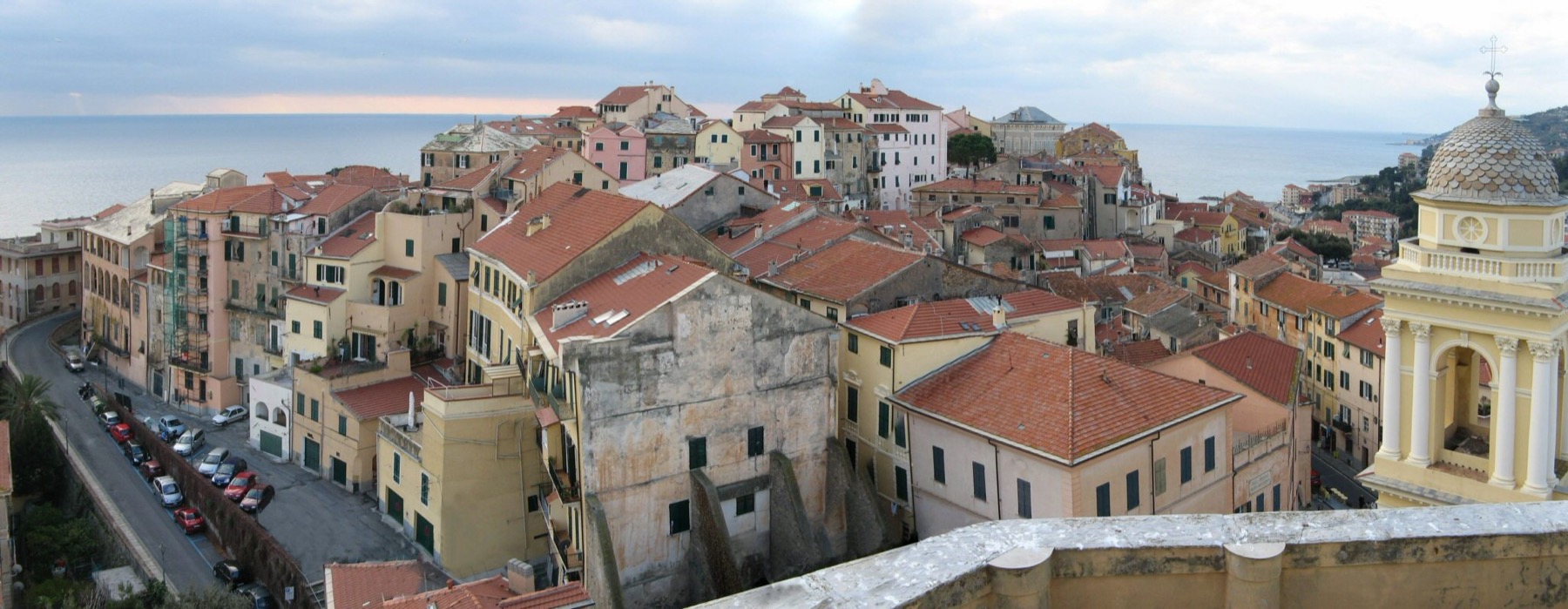 The rooftops of the Parasio spiralling down towards the sea, seen from above
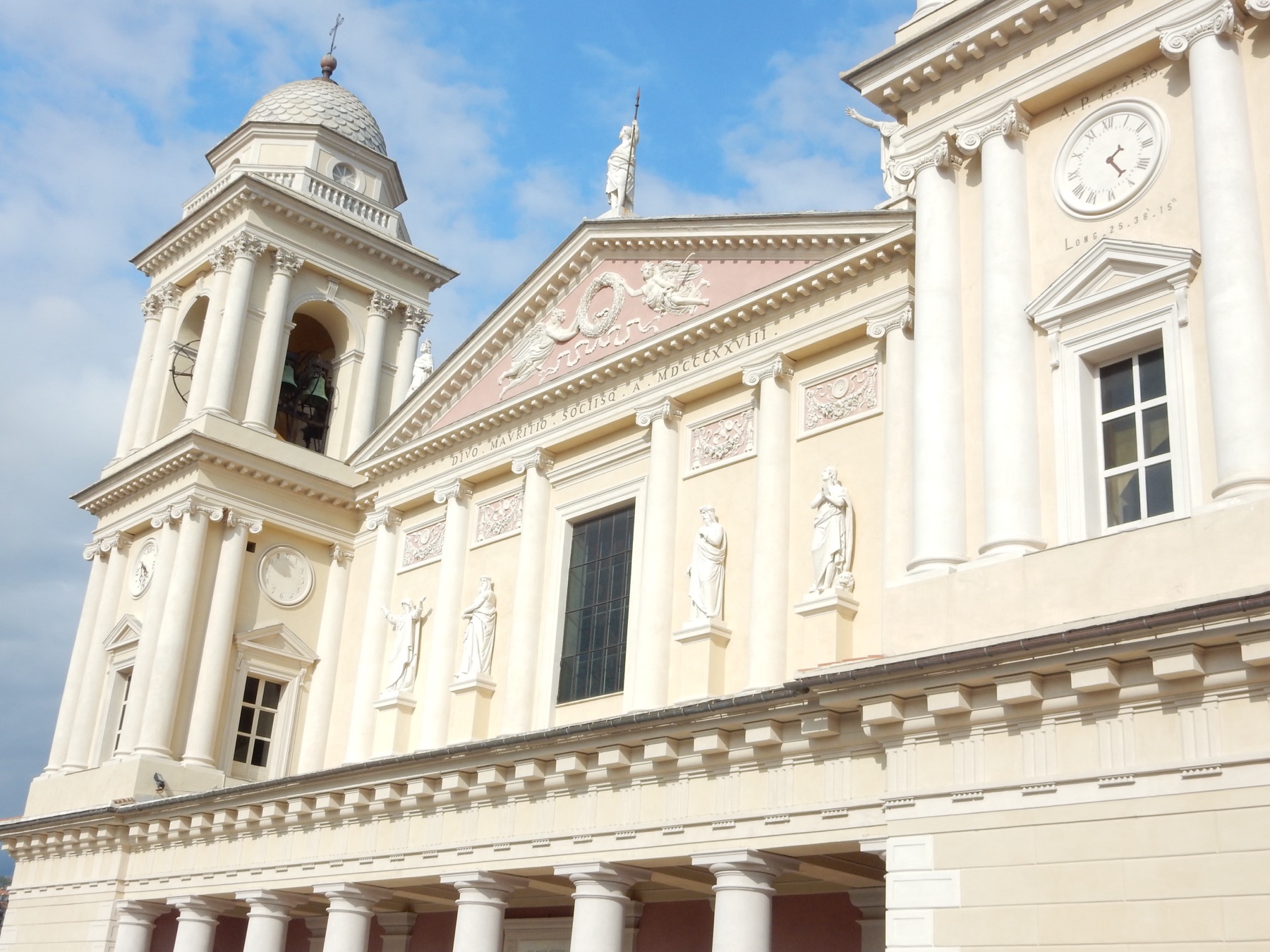
At the top sits the Duomo di San Maurizio, and it's the reason people climb up even just for a photo. It's the largest church in Liguria, and that's not brochure talk: it's numbers. Roughly seventy metres by forty, three thousand square metres, a neoclassical facade that hits you when you pop out of the narrow alleys and it's a whole other world. They built it between 1781 and 1838 to a design by Gaetano Cantoni, full-blown neoclassical, columns, pediment, grand steps. Inside it's even more striking: three naves, around a hundred Corinthian columns, a dome that reaches over thirty metres inside. The lantern on top brushes fifty metres off the ground, and it's the landmark you can see from half of Imperia, our house in Oneglia included.
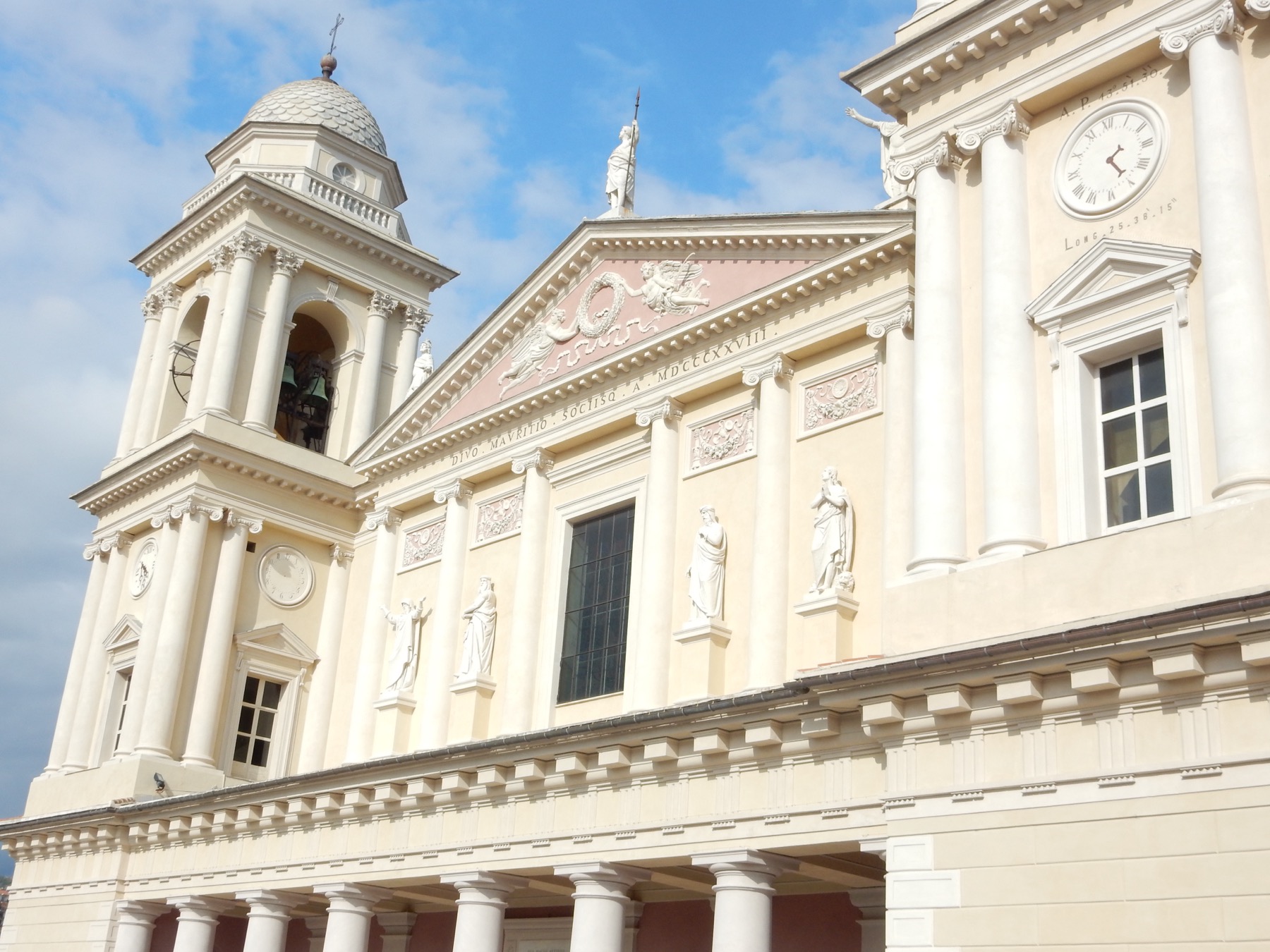 The neoclassical facade of the Duomo di San Maurizio, with its bell tower and statues
Let me be honest about one thing: the Duomo, as it stands, is a slap of grandeur, but it isn't the oldest part of the Parasio. It's nineteenth-century, wealthy, built to tell the world how much Porto Maurizio mattered back when the sea made money. The real medieval town is the alleys around it, the arches that vault over the road, the stone doorways, the hanging gardens that poke out behind a wall. The Duomo is the crown; the old town is the head that wears it. I love both, but if you're short on time, the thing not to miss isn't the church: it's losing yourself in the caruggi below.
And here I come to the spot I love most, the one I go back for: the Logge di Santa Chiara. They sit behind the convent of the Poor Clares, looking out over nothing. It's a long arched loggia, built in 1713 on the bastions and old walls of the town, and the moment you get there you understand why they put it exactly there: below there's nothing, just the sea, sheer drop. You walk under the arches and on one side you have the stone of the convent, on the other the open gulf. It's the spot where couples come to exchange promises — innocent ones, of course — because with that view of the sea in front of you it comes naturally, and all of a sudden the thing feels more serious than they'd bargained for. At sunset, with the light slanting in between one arch and the next, it's the finest spot in all of Imperia, and that's me, a man from Oneglia, saying it, which is already a concession (on the whole Oneglia-versus-Porto business I wrote a separate piece, I won't repeat myself here).
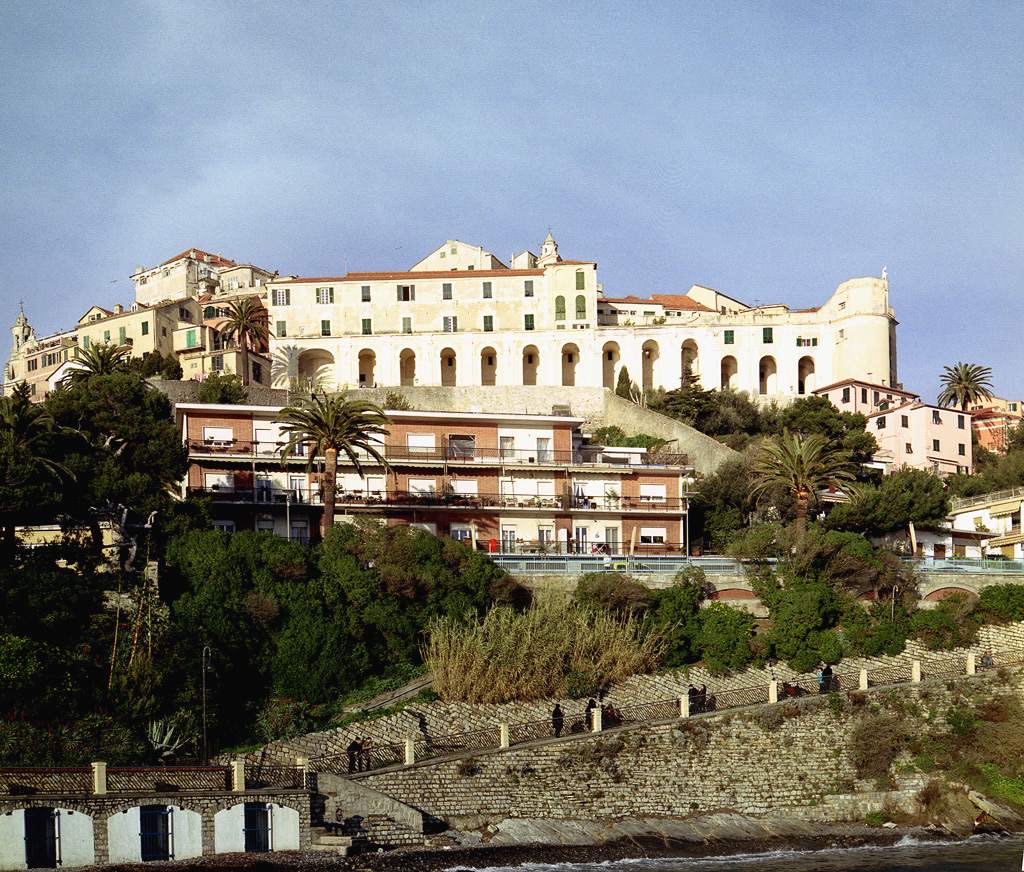 The Logge di Santa Chiara: the long arched portico of the convent, atop the Parasio, sheer above the sea
The convent behind the loggia is real, lived in, not a museum. The cloistered Poor Clares have been there since 1365, women who chose never to go out again, and behind that wall they still are today. It does something to me to think about it: you're up on the loggia enjoying the most open view in the city, and two metres from you is someone who decided to give it up. They built the loggia to face outwards; the nuns live facing in. In summer, some evenings, they hold concerts under those arches, the "Concerti delle logge", and listening to music there, with the black sea in front of you, is one of those things that happen in Imperia and stay with you.
And every so often the loggia becomes the stage for fine ideas. In 2019, for instance, the photographer Settimio Benedusi put on "The dinner of silence" here: a single hundred-seat table set under the arches, facing the sea, a dinner eaten in silence, with a piano concert and a part devoted to scents. It wasn't an artist's whim: the proceeds went to restoring the loggia itself, which needed it. It sold out, and those walls came back as good as new. It's the kind of thing that happens here now and then — and it tells you how loved this place is.
As you wander the old town, look up now and then. The noble palaces are still here, even if most can't be visited: Palazzo Strafforello, Palazzo Gandolfo, Palazzo Littardi, stone doorways, a fresco or two behind closed shutters. Porto Maurizio, before the sea stopped paying, was a place of shipowners and wealthy families, and it shows. This isn't a fake-poor postcard village: it was well-off, and it has kept the bones of it.
Two practical warnings, because I'd rather tell you myself. First: you climb, and you climb a fair bit, staircases included. Comfortable shoes, and if it's hot take it slow, in the shade of the alleys. But if the climb really isn't for you — maybe you've just spent the afternoon on the beach at Borgo Marina, right below — there's the shortcut few tourists know about: two public lifts. The first takes you from the quarter up to the Aurelia, the second from there up to the Parasio. Go up the easy way, no excuses, and then enjoy the walk down, which is the best part: down through the caruggi, with the sea widening at every turn. Second: the Parasio is above all for walking and looking, it isn't full of bars and shops. There are a few places, but it's a quiet residential quarter, not a strolling street. If you want some buzz, that's down on the waterfront in Oneglia or along the seafront in Porto. Up here you come for the silence, the stone and the views.
From our house it's ten minutes by car. My advice is to pair it with dinner down in Porto Maurizio, or on the way back towards Oneglia: climb up in the afternoon light, stay on the loggia for the sunset, and come down once the first lights are on. The Parasio, in the evening, is one of those things that make you understand why, after twenty years, I can't get this town out of my head.
Where to find it
- The Logge di Santa ChiaraAn arched loggia from 1713, built on the bastions of the old walls, behind the convent of the cloistered Poor Clares. A belvedere on a sheer drop to the sea, the finest spot in the Parasio. In summer it hosts the "Concerti delle logge". Open view over the gulf, free to reach as you walk the old town.Parasio, Porto Maurizio (Imperia)
- Duomo di San MaurizioThe largest church in Liguria: roughly 70×40 metres, three thousand square metres, a neoclassical facade designed by Gaetano Cantoni (1781-1838). Three naves, around a hundred Corinthian columns, a dome lantern nearly 50 metres off the ground. At the top of the old town.Piazza Duomo, Porto Maurizio (Imperia)
- The Parasio old townPorto Maurizio's medieval quarter, built as a spiral for defence: caruggi and staircases winding up to the Duomo, arches over the road, hanging gardens and noble palaces (Strafforello, Gandolfo, Littardi). Almost entirely pedestrian, sea views at every turn. Best done on foot, at sunset.Parasio, Porto Maurizio (Imperia)